
Why go
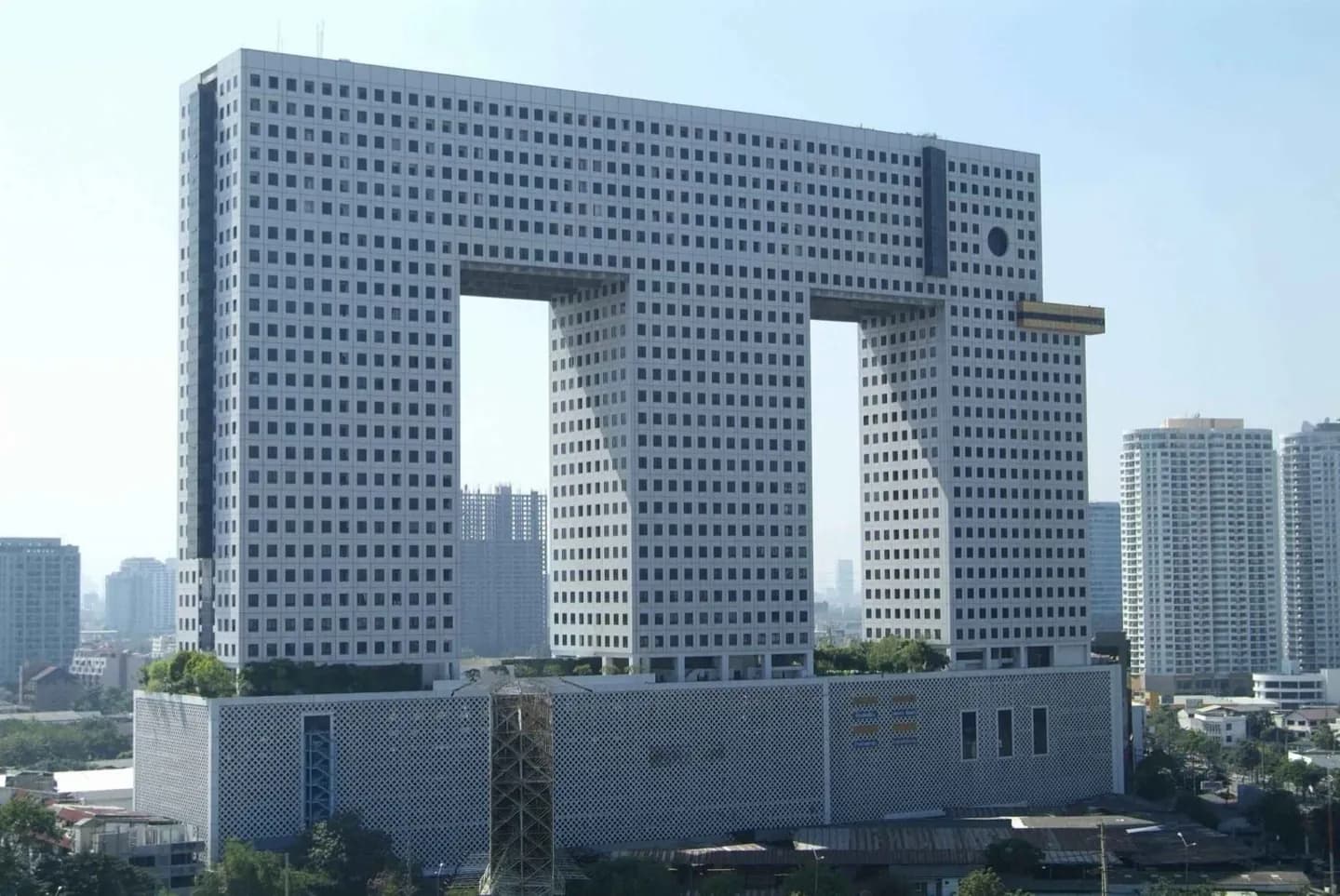
This is an architectural sight rather than a conventional attraction. Seen from a suitable distance, its towers become legs and trunk, windows become eyes and projecting forms suggest tusks. The playful outline makes late-twentieth-century Bangkok’s appetite for expressive commercial architecture immediately visible.
What to look for
- Read the Elephant Building’s three connected towers as an elephant silhouette.
- Spot the oversized circular windows used as the elephant’s eyes.
- See the Elephant Building as a postmodern landmark completed in 1997.
The full story
Completed in 1997, the Elephant Building—also called the Chang Building—stands at the meeting of Phahonyothin and Ratchadaphisek roads in Chatuchak. Architect Ong-ard Satrabhandhu and developer Arun Chaisaree turned a mixed-use high-rise into a piece of urban imagery. Three towers establish the animal’s legs and trunk, upper bridges form the body, round windows become eyes, and projecting yellow elements suggest tusks. Behind the joke is a working complex containing offices and residences. Its fame comes from the way those ordinary building functions were assembled into a form that can be understood at a glance. From far enough away, the separate masses lock together and the elephant appears across the skyline. The building rises 32 floors, making the visual joke monumental rather than decorative.
Useful to know
- View the building from public space and do not assume its offices or residences are open to visitors.
- Choose a distant angle; the elephant form reads more clearly as a complete silhouette.
- Avoid planning a dedicated interior visit unless access has been confirmed directly.
Your next visit
Estimated · Declared scenario and planning estimates; no live opening, weather, queue or booking service.
Outdoor visit · 30–45 min
World planning estimate; admission, opening, visit duration and access need checking.