
Why go
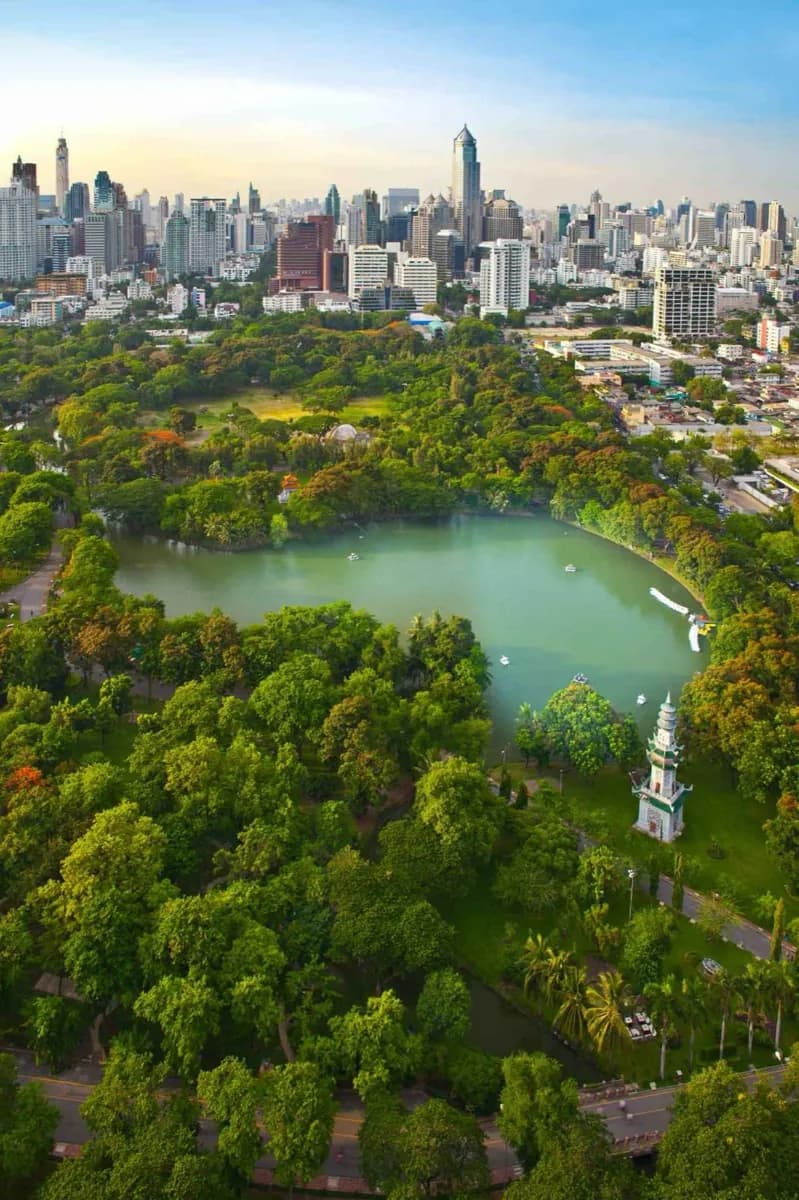
Lumphini provides more than relief from traffic. Its loop paths, water and birdlife reveal how Bangkok uses shared outdoor space, while the statue of Rama VI connects the landscape to the king who gave the land for a public park. The contrast with nearby Silom’s towers is immediate and easy to read.
What to look for
- An artificial lake and paths extend around Lumphini Park.
- Mature trees support a varied urban bird population in Lumphini Park.
- A statue of Rama VI stands near Lumphini Park’s southwestern entrance.
The full story
Lumphini Park began on royal land provided by King Rama VI in the 1920s. An early exhibition and museum project on the site gave way to a public park, one of Bangkok’s first large civic landscapes. The name refers to Lumbini, traditionally identified as the Buddha’s birthplace in Nepal. During the Second World War, the grounds were used as a Japanese army camp, adding a less visible historical layer to today’s recreational setting. The park now sits within the central business district, bordered by major roads and close to Silom. Its artificial lake, mature trees and network of paths support exercise, rest and birdlife in a part of the city dominated by towers and traffic. A statue of Rama VI stands near the southwestern entrance, tying the everyday public landscape to its royal founder. The park’s value lies in observing this continuing civic use, not simply escaping the surrounding city.
Useful to know
- Use the lake and main paths as a simple loop instead of trying to cover every facility.
- Combine the park with Silom, entering or leaving near the Rama VI statue and transit interchange.
- Plan for heat, sun and rain; most of the experience is outdoors despite areas of tree cover.
Your next visit
Estimated · Declared scenario and planning estimates; no live opening, weather, queue or booking service.
Outdoor visit · 30–45 min
World planning estimate; admission, opening, visit duration and access need checking.