
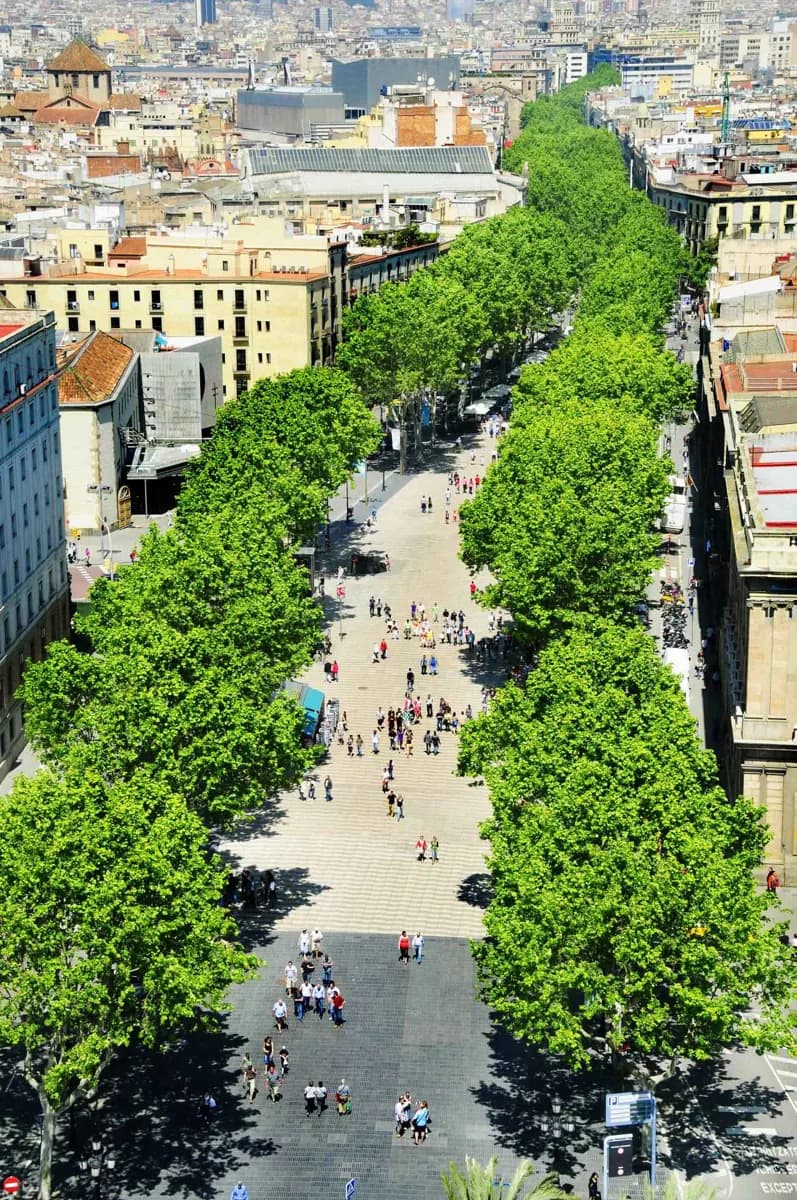
Why go
The promenade forms a useful seam between the Gothic Quarter and El Raval. Its changing names mark different stretches, from Canaletes to Santa Mònica; the Boqueria, Liceu and passages toward Plaça Reial help turn a simple walk into an introduction to the old city.
What to look for
- The Font de Canaletes marks the northern Rambla stretch.
- The Boqueria and Liceu anchor the central walk.
- Side passages lead toward Plaça Reial and the Gothic Quarter.
The full story
La Rambla is a sequence of shorter rambles rather than one uniform boulevard. Its Catalan plural, Les Rambles, reflects stretches once named for a fountain, a former university, flowers, religious houses and the convent of Santa Mònica. The first trees were planted in 1703. Today the walk still marks an easy boundary between the dense streets of the Gothic Quarter to the east and El Raval to the west. That contrast matters more than treating the promenade as a single attraction. Near the center, the Boqueria and Liceu supply two very different reasons to step off the main flow; farther south, the Columbus Monument and old port show where the street meets the water. A turn toward Plaça Reial leads into a nineteenth-century square with palms and lamps associated with Gaudí. Walking the full length makes sense as orientation, but the history and varied side streets reward a few deliberate detours.
Useful to know
- Walk it as a link between Plaça de Catalunya and Port Vell, using side streets for deeper exploration.
- Keep belongings close in the busiest sections.
- Check for local diversions where renovation work affects the promenade.
Your next visit
Estimated · Declared scenario and planning estimates; no live opening, weather, queue or booking service.
Outdoor visit · 25–50 min
World planning estimate; admission, opening, visit duration and access need checking.