
Why go
Berliners often call it simply Alex, referring to a larger neighbourhood stretching from Mollstraße in the northeast to Spandauer Straße and the Rotes Rathaus in the southwest. History Early history Originally a cattle market outside the city fortifications, it was named in honor of a visit of the Russian Emperor Alexander I to Berlin on 25 October 1805 by order of King Frederick William III of Prussia.
What to look for
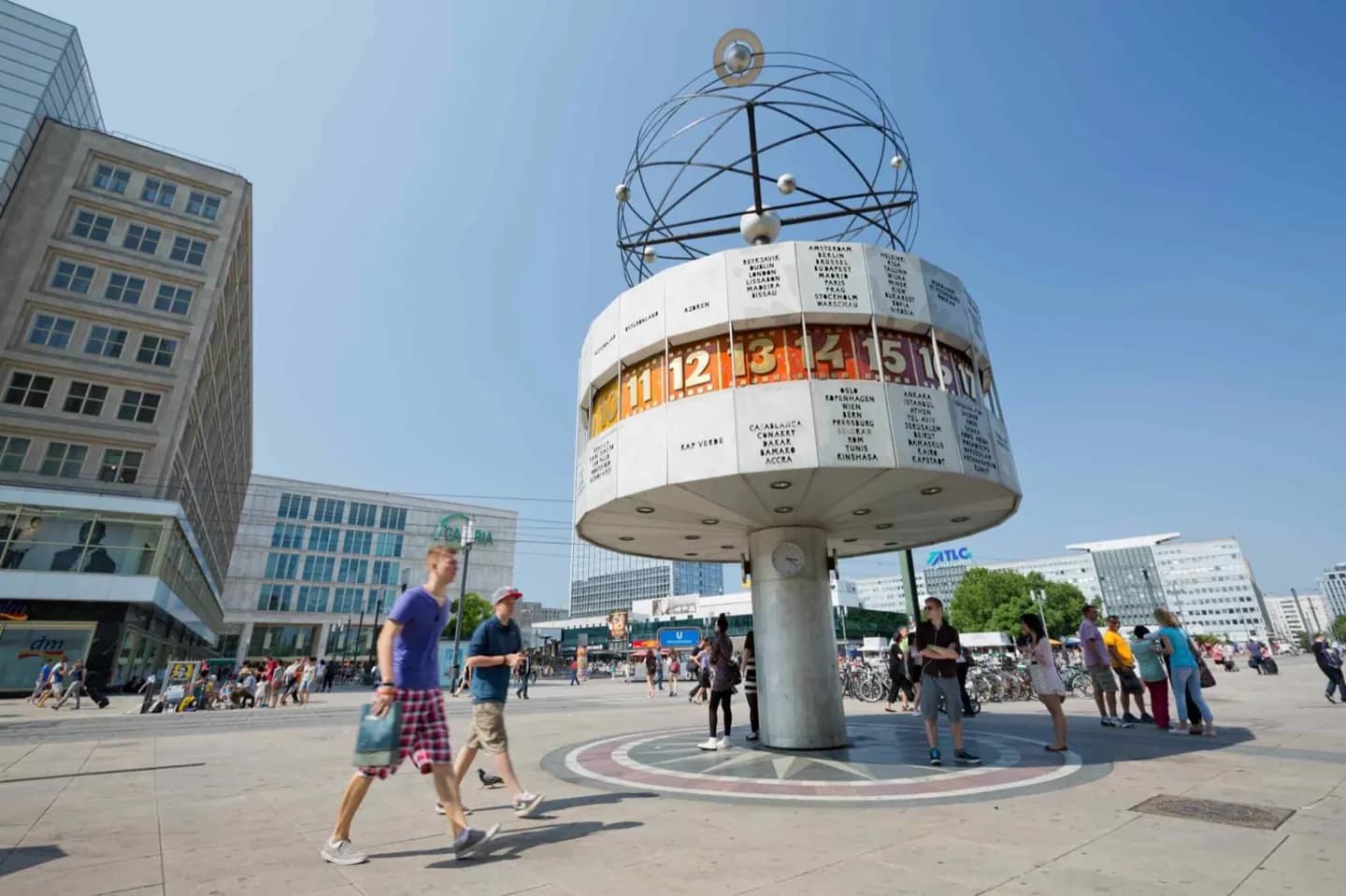
- The World Clock, TV Tower sightline and broad GDR-era square make Alexanderplatz a useful urban-history stop and.
The full story
The U-Bahn station of the present-day U2 line opened on 1 July 1913. Its heyday was in the 1920s, when together with Potsdamer Platz it was at the heart of Berlin's nightlife, inspiring the 1929 novel Berlin Alexanderplatz (see 1920s Berlin) and the two films based thereon, Piel Jutzi's 1931 film and Rainer Werner Fassbinder's 15½ hour second adaptation, released in 1980. About 1920 the city's authorities started a rearrangement of the increasing traffic flows laying out a roundabout, accompanied by two buildings along the Stadtbahn viaduct, Alexanderhaus and Berolinahaus finished in 1932 according to plans designed by Peter Behrens. East Germany Alexanderplatz has been subject to redevelopment several times in its history, most recently during the 1960s, when it was turned into a pedestrian zone and enlarged as part of the German Democratic Republic's redevelopment of the city centre.
Useful to know
- Visit in daylight for the clearest reading of the architecture and surrounding urban space.
- Combine the stop with nearby sights on foot, allowing extra time only for any separate interior component.