
Why go
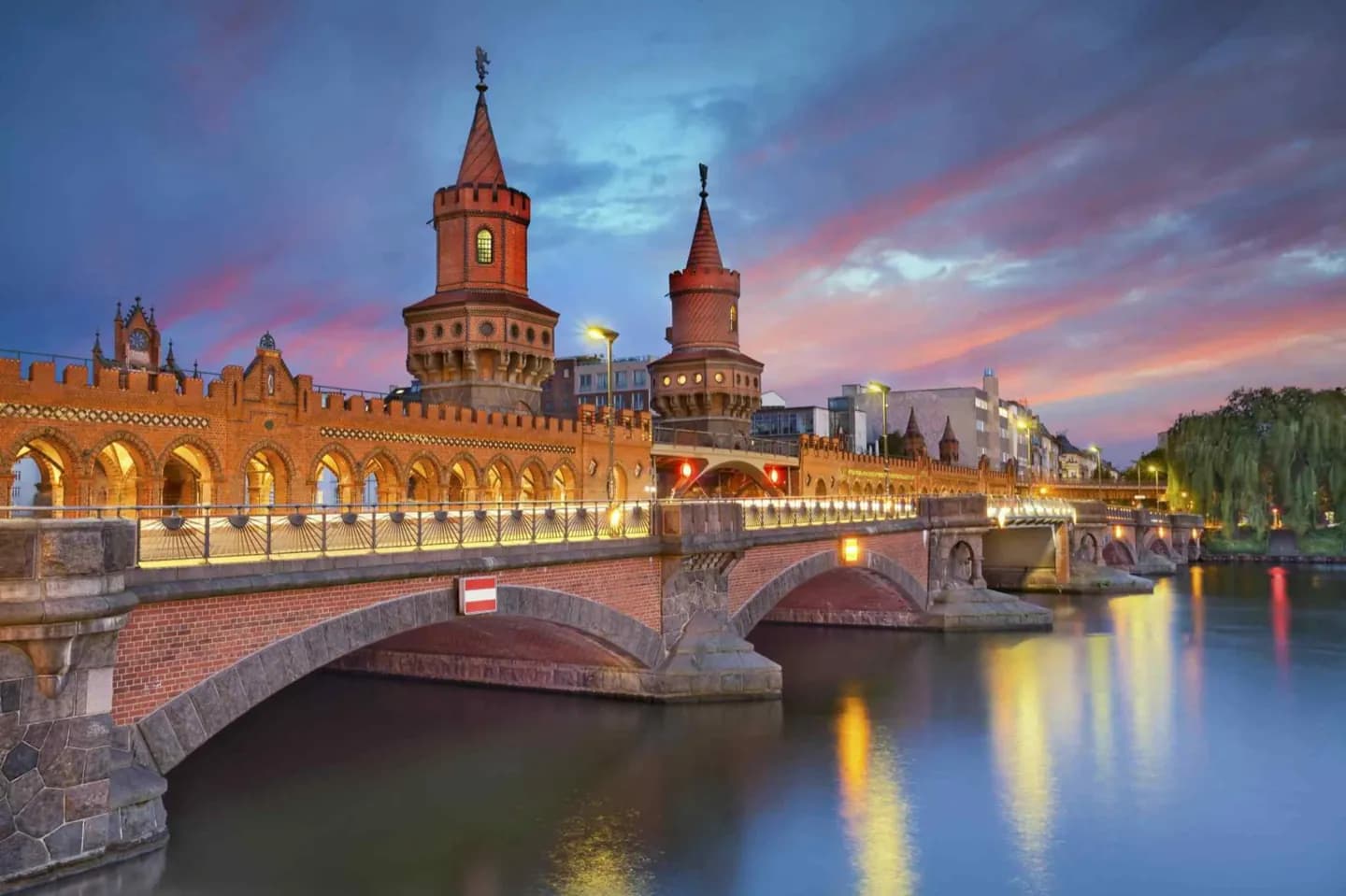
It links Friedrichshain and Kreuzberg, former boroughs that were divided by the Berlin Wall, and has become an important symbol of Berlin’s unity. The lower deck of the bridge carries a roadway, which connects Oberbaum Straße to the south of the river with Warschauer Straße to the north.
What to look for
- The brick, turreted bridge crosses the Spree between Kreuzberg and Friedrichshain and frames views toward the East.
The full story
The bridge appears prominently in the 1998 film Run Lola Run. History The bridge is built on the former boundary of the municipal area with its rural environs, where an excise wall was built in 1732. A wooden drawbridge was built as part of the wall; it served as a gate to the city. The name Oberbaumbrücke stemmed from the heavy tree trunk, covered in metal spikes, that was used as a boom to block the river at night to prevent smuggling. (Baum means tree or wooden beam in German; thus the name means something like "Upper Tree Bridge"; there was another tree-trunk barrier at the western end of the contemporary city limits, close to today's Unterbaumstraße (lit. in English: Lower Tree Street.) By 1879 the wooden bridge had been modified greatly.
Useful to know
- Visit in daylight for the clearest reading of the architecture and surrounding urban space.
- Combine the stop with nearby sights on foot, allowing extra time only for any separate interior component.
Your next visit
Estimated · Declared scenario and planning estimates; no live opening, weather, queue or booking service.
Outdoor visit · 15–25 min
An exterior riverbank view; crossing the bridge is optional.