
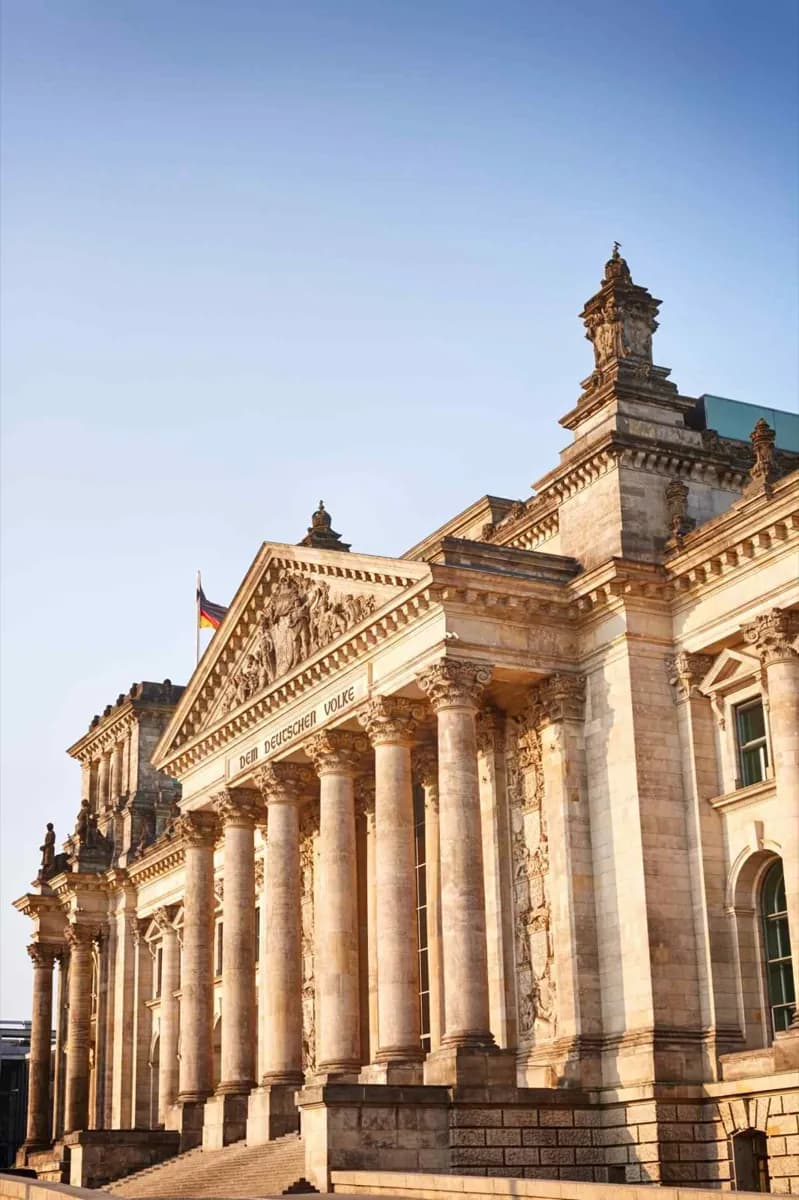
Why go
It was opened in 1894 and housed the Diet until 1933, when it was severely damaged after it was set on fire. After World War II, the building fell into disuse; the parliament of the German Democratic Republic (the Volkskammer) met in the Palast der Republik in East Berlin, while the parliament of the Federal Republic of Germany (the Bundestag) met in the Bundeshaus in Bonn.
What to look for
- The glass dome frames views over the parliamentary quarter and follows a 230-metre spiral ascent and descent.
The full story
After its completion in 1999, it once again became the meeting place of the German parliament: the modern Bundestag. The term Reichstag, when used to connote a diet, dates back to the Holy Roman Empire. The building was built for the Diet of the German Empire, which was succeeded by the Reichstag of the Weimar Republic. The latter would become the Reichstag of Nazi Germany, which left the building (and ceased to act as a parliament) after the 1933 fire and never returned; the term Reichstag has not been used by German parliaments since World War II. In today's usage, the German word Reichstag (Imperial Diet Building) refers mainly to the building, while Bundestag (Federal Diet) refers to the institution.
Useful to know
- Verify current opening hours, closures and timed-entry rules on the official visitor page before setting out.
- Allow extra time for security or ticketing when the visit includes an interior collection or viewing platform.
Your next visit
Estimated · Declared scenario and planning estimates; no live opening, weather, queue or booking service.
Outdoor visit · 15–25 min
Exterior only. Dome access is not included.
Indoor visit · 45–60 min
Advance registration and security access must be confirmed separately.