
Why go
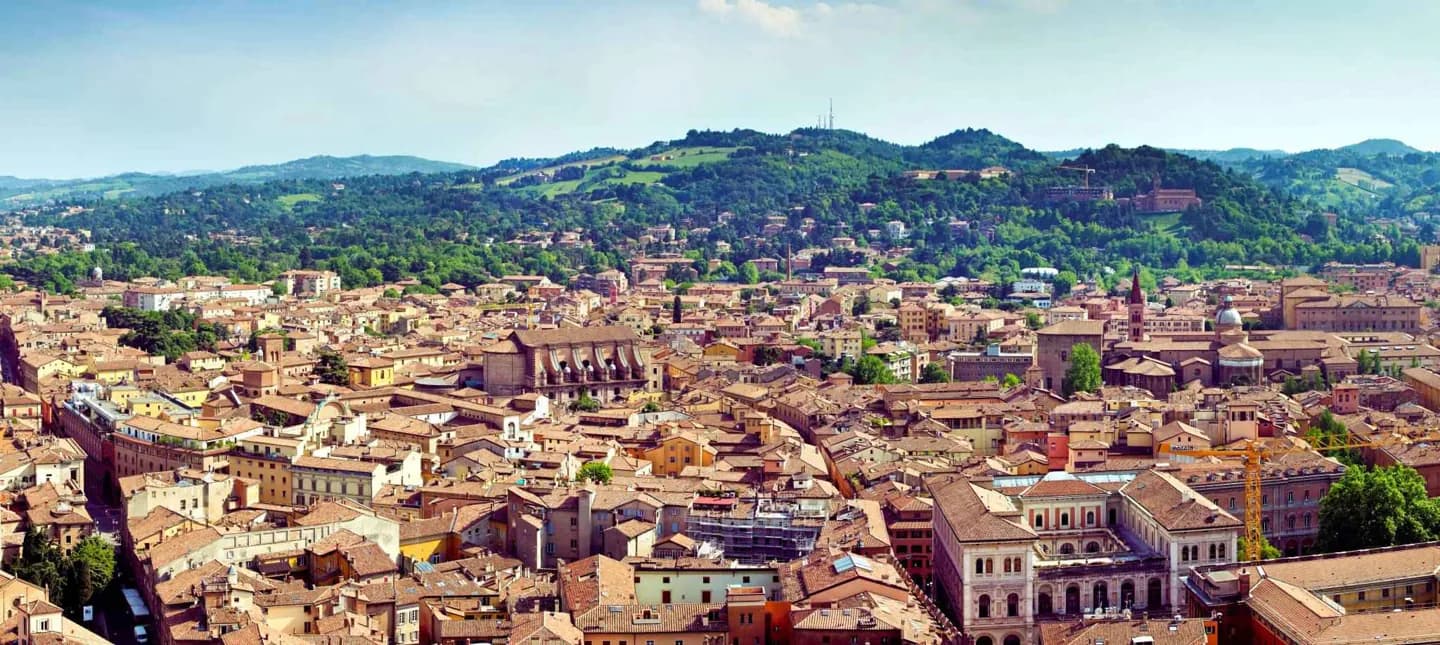
This geography helps you plan a realistic day. The main civic, university and market streets lie in a compact urban centre, while the sanctuary of San Luca rises above it on Colle della Guardia. The porticoes change the feel of a walk, but the hill remains a physical commitment.
The full story
Bologna occupies a hinge between two landscapes. To the north, the Po Plain spreads into a broad lowland of roads, farms and rail connections. To the south, the Apennine foothills begin to lift the city toward higher ground. The Reno and Savena valleys frame this position, although their watercourses are less useful to a visitor than the visible change in terrain. That contrast explains why Bologna can feel compact on one outing and unexpectedly demanding on another. Piazza Maggiore, the Two Towers and the university quarter belong to a walkable central network. San Luca stands on Colle della Guardia above the city; the long portico leading to it offers a memorable ascent, not an extension of a flat shopping stroll. The plain also helps explain Bologna's historical role as a junction between different parts of Italy. Use the centre for dense sequences of buildings and museums, then allow a separate block of time and effort for the hills. Seasonal weather changes how comfortable those exposed sections feel, so check the forecast before committing to the ascent.
Useful to know
- Keep Piazza Maggiore, the Two Towers and the university quarter together for a mostly central walk.
- Allow a separate outing for the portico ascent to San Luca; the route climbs to Colle della Guardia.
- Check the day's forecast before a long hill walk, especially in heat or rain.