
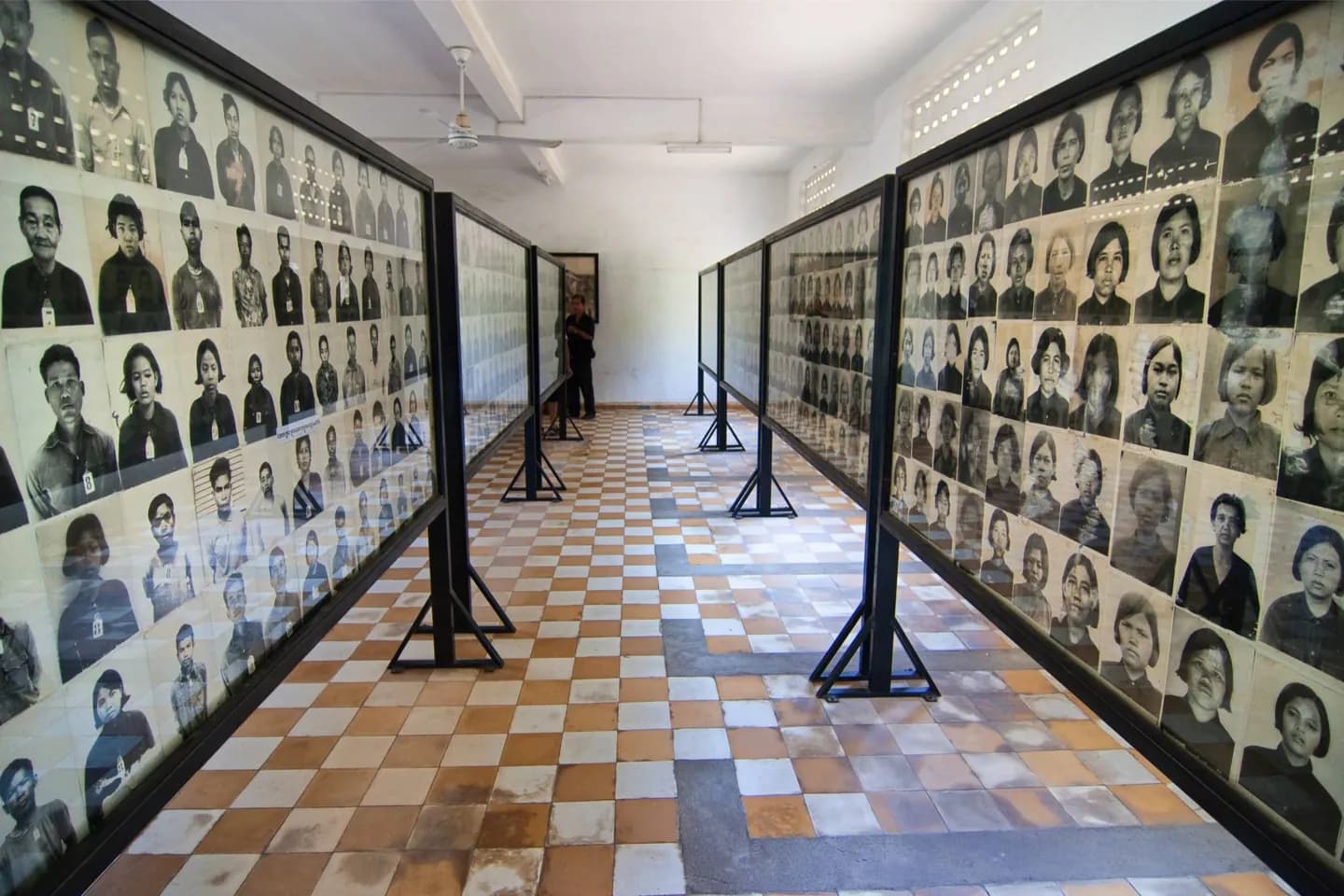
Why go
This history is essential context for Tuol Sleng and the killing fields near Phnom Penh. It explains why those memorials address people of many backgrounds, including ethnic Khmer and Cham Muslims, and why the peace process stretched long past the end of Khmer Rouge rule.
The full story
After taking Phnom Penh in April 1975, the Khmer Rouge renamed the country Democratic Kampuchea. Under Pol Pot, the regime emptied cities and forced people into rural labor. It dismantled institutions, targeted perceived opponents and persecuted minority communities. Around two million people died from execution, forced labor, starvation and disease; estimates vary. Tuol Sleng, also called S-21, became a prison and interrogation center, while mass graves across the country are often called the killing fields. The regime attacked Vietnamese communities and Cham Muslims, among others, but most victims were ethnic Khmer. Teachers, doctors and other educated people were also at risk. These facts matter at memorials because the losses cannot be explained as a conflict affecting only one group. Approach survivor accounts, photographs and graves as evidence of individual lives rather than as spectacle. Vietnam invaded in late 1978 after Khmer Rouge border attacks, and Phnom Penh fell in January 1979. A Vietnamese-backed government took power, while armed resistance and displacement continued. Peace talks led to the 1991 Paris agreements. The United Nations Transitional Authority in Cambodia then supervised a ceasefire, repatriation efforts and elections. The transition established a new political framework, but it did not make the social consequences of the regime disappear.