
Why go
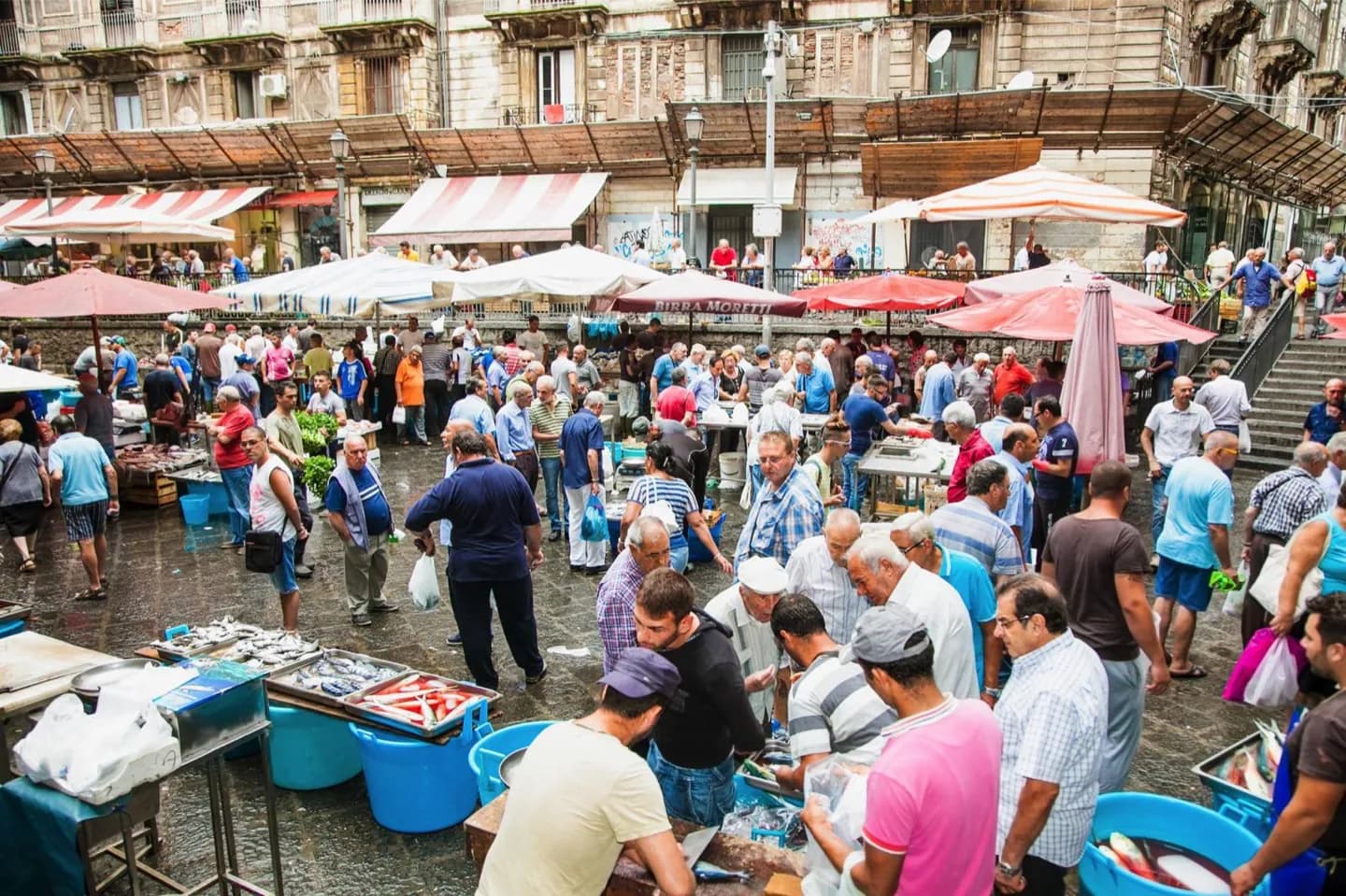
La Pescheria grew around the old walls near Piazza Alonzo di Benedetto and Piazza Pardo, close to the cathedral. Fera o Luni moved through the city before settling at Piazza Carlo Alberto. Visiting the two areas shows how trading places shifted as Catania expanded, without confusing the fish market with the broader fair.
The full story
Commerce has long shaped Catania’s public squares. The market known as Fera o Luni once occupied a site near the royal chapel, later moved to Piazza Università, and eventually took its place at Piazza Carlo Alberto. La Pescheria developed on another path. In the early nineteenth century, a gallery for the fish market was cut into the embankment of the sixteenth-century walls. Trading spread into the neighbouring squares, including Piazza Alonzo di Benedetto and Piazza Pardo. Those locations explain why the two historic markets feel connected to different parts of the centre: one sits in the cathedral’s orbit, while the other belongs to a broader network of streets and squares farther north. The local practice of calling out goods, known as vuciata, is part of the markets’ remembered trading culture. What is for sale, and when stalls operate, can change; the geography and history of the market spaces are the lasting reasons to compare them.
Useful to know
- Treat La Pescheria near the cathedral and Fera o Luni at Piazza Carlo Alberto as separate visits.
- Check current market activity before making either market the purpose of a timed trip.