
Why go
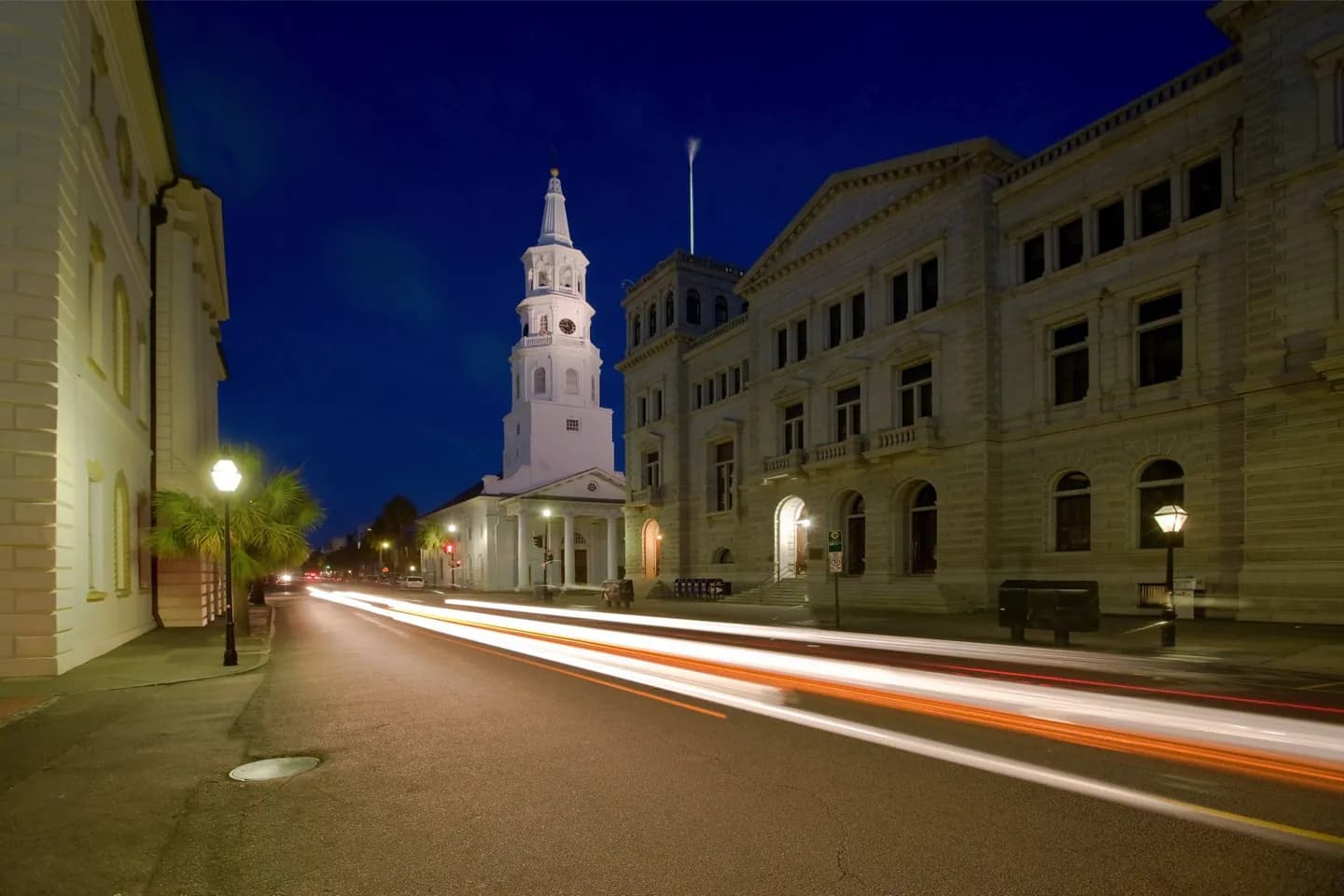
The street is useful for reading the city rather than checking off a single attraction. At Broad and Meeting, the courthouse, City Hall, church, and federal building show how civic authority gathered in one place. Farther east, the Old Exchange ties that streetscape to the port.
What to look for
- The four civic buildings around the Broad and Meeting intersection, known as the Four Corners of Law.
- The Old Exchange at Broad Street's eastern end, where the street meets East Bay Street.
- The shift toward residential buildings and a live oak canopy west of Legare Street.
The full story
Broad Street was laid out as an east to west connector in Charleston's 1680 peninsula plan. Merchants and craftspeople occupied much of its eastern stretch in the colonial period. The group of civic buildings at Broad and Meeting later made the intersection a center of legal and public life. At the harbor end, the Old Exchange linked those institutions to trade and to the disputes that preceded American independence. The street also records later changes. British siege, the Civil War, and redevelopment all altered its buildings. Charleston's historic district protections, beginning in the twentieth century, helped keep the older streetscape legible, although what survives is a selective record of the city's past. West of Legare Street, the character changes from civic and commercial frontage toward houses and trees. That change in scale is as revealing as any single facade.