
Why go
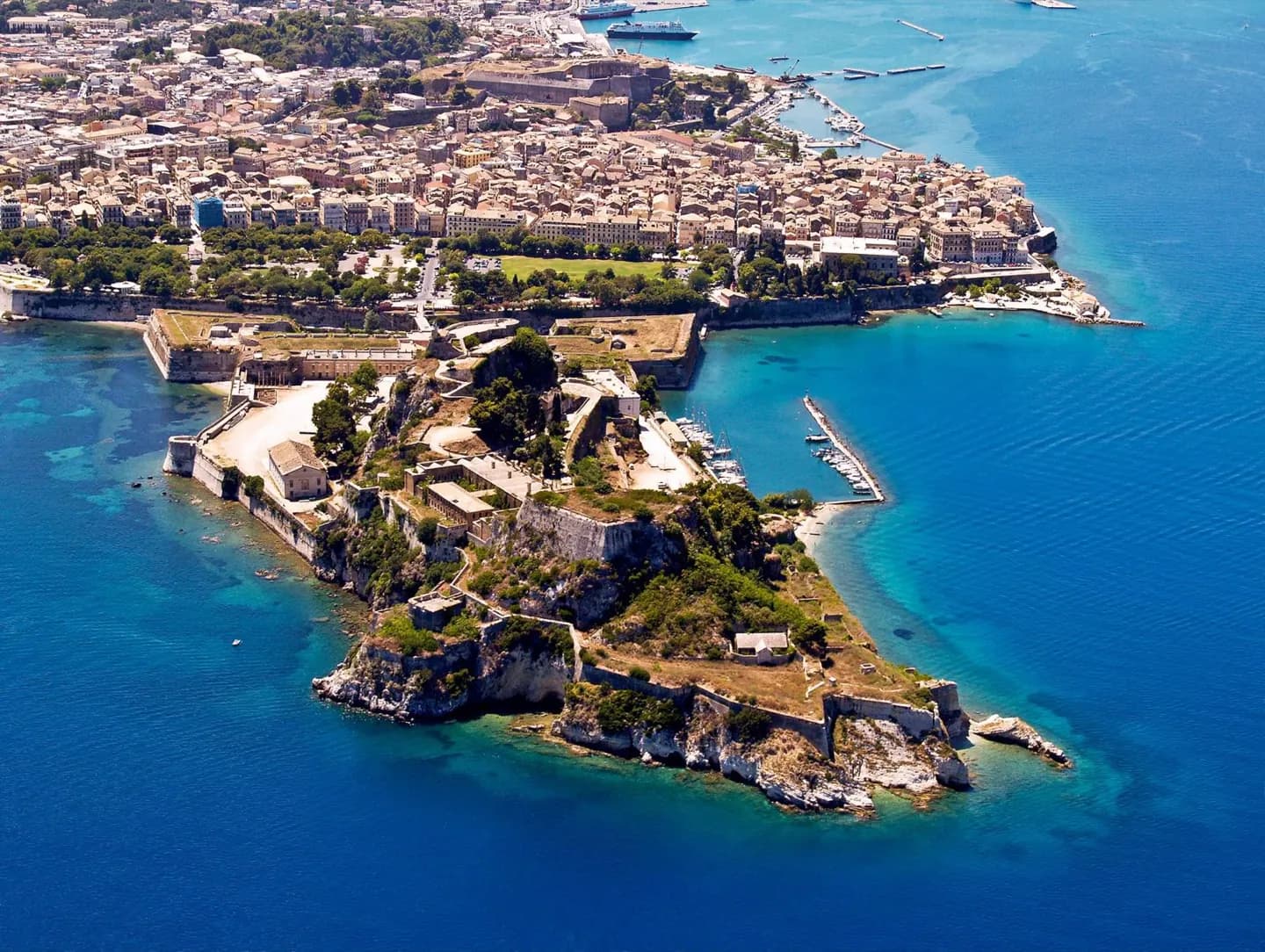
The island's geography helps you choose a realistic base or day trip. Corfu city and its harbour face east toward the mainland, while the Pantokrator range gives the north a steeper character. Palaiokastritsa and the western coast offer a different sequence of bays, headlands and open water views.
The full story
Corfu lies in the Ionian Sea, close to the Albanian coast at its northeastern end and opposite the Greek mainland farther south. Its long, curved outline was compared in antiquity to a sickle. The concave eastern side holds Corfu city and its harbour, a useful clue to the island's historic connections by sea. The northern part rises into the Pantokrator range. The centre is more undulating, and much of the south is lower. This changing relief matters on the ground: a route that looks short across the island can involve hills and winding roads, while a coastal drive may move through a series of separate bays rather than one continuous resort strip. From high ground, the sea and nearby mainland help you read the island's position. For a first visit, choose one coastal area and one inland or city anchor instead of assuming all of Corfu can be covered in a single outing.
Useful to know
- Allow extra travel time for hill and cross-island routes, especially when pairing the north with a west-coast stop.