
Why go
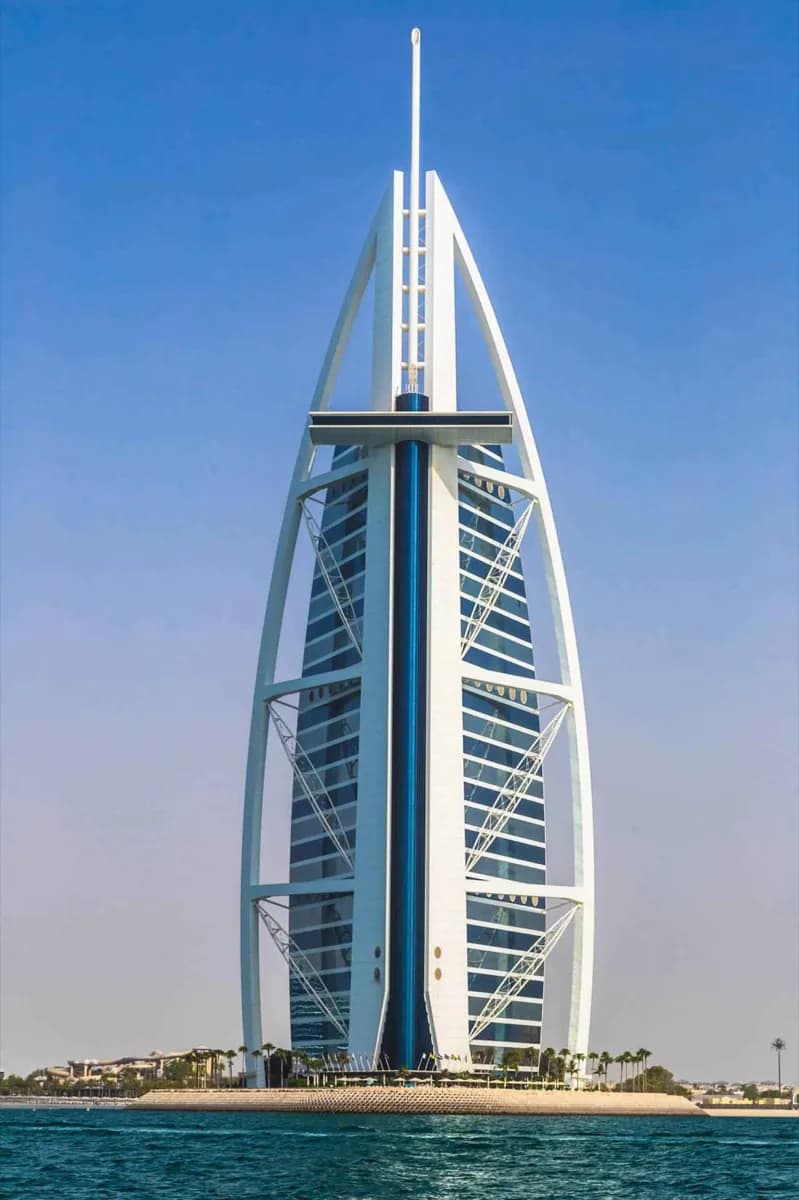
The hotel is one of Dubai's clearest exercises in symbolic architecture. Its billowing-sail outline, offshore position and vast central atrium were designed as a single landmark composition, best understood in relation to the sea and nearby wave-shaped Jumeirah Beach Hotel.
What to look for
- Two curved wings form a sail around a tall enclosed atrium.
- A private bridge links the hotel to an artificial island off Jumeirah beach.
- The helipad projects near the roof, interrupting the otherwise sail-like outline.
The full story
Burj Al Arab was conceived as a building that would become visually synonymous with Dubai. Architect Tom Wright led the design for Atkins, shaping two wings into the form of a billowing spinnaker around a vast internal atrium. Construction began in 1994, starting with an artificial island off the Jumeirah coast. Engineers secured the foundation with deep concrete piles and protected the reclaimed land with rock and a concrete honeycomb barrier against erosion. The hotel opened in 1999. Its offshore site is part of the effect: distance from the mainland allows the sail outline to remain legible against sea and sky. The surrounding coast was once known as Chicago Beach, a name linked to the Chicago Bridge & Iron Company and its work on large floating oil-storage tanks in the area. The nearby wave-shaped Jumeirah Beach Hotel makes the architectural pairing especially clear, turning two resort buildings into a composed waterfront scene.
Useful to know
- Plan an exterior view unless you hold a confirmed hotel, dining or visitor-experience booking.
- Compare the sail silhouette with the wave form of Jumeirah Beach Hotel from the same coastal area.
- Check the official site before attempting entry because the hotel has no single public visitor schedule.
Your next visit
Estimated · Declared scenario and planning estimates; no live opening, weather, queue or booking service.
Outdoor visit · 30–45 min
World planning estimate; admission, opening, visit duration and access need checking.