
Why go
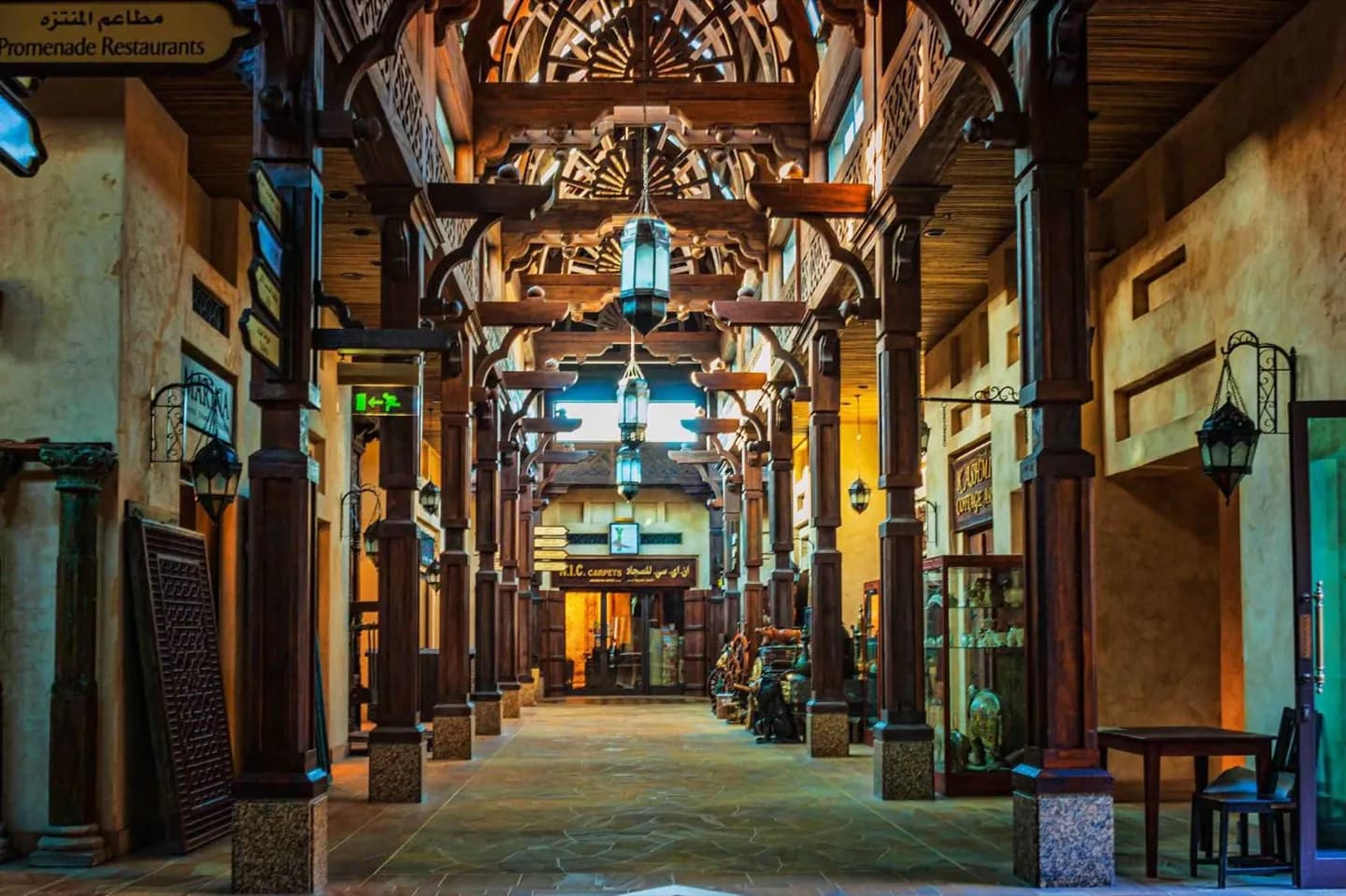
Go to see a low-rise resort district arranged around waterways, with Burj Al Arab views and a walkable souk setting. It fits a slower afternoon of wandering and dining beside the coast, while remaining more curated than an older Dubai neighborhood.
What to look for
- Waterways and abras link much of the resort's hotels and public-facing areas.
- Wind towers, courtyards and souk-like passages evoke older Gulf settlements.
- The turtle sanctuary rehabilitates injured turtles before release to the wild.
The full story
Madinat Jumeirah was planned as a contemporary resort shaped around an idealized Arabian town. The first phase, Mina A'Salam—‘Harbour of Peace’—opened in 2003. Later hotels and summerhouse-style accommodation expanded the complex across gardens, beachfront and a network of waterways. Its design borrows recognizable elements from older Gulf settlements: wind towers punctuate the skyline, courtyards break up the mass of the buildings, and narrow passages lead toward a souk. Abras move along waterways that connect much of the resort, making water part of the circulation rather than just decoration. The names reinforce the concept: Al Qasr means ‘The Palace,’ while Dar Al Masyaf refers to summerhouse-style retreats. The waterways also support a turtle rehabilitation sanctuary for injured animals before release. The important distinction is that this is not an old neighbourhood. It is a modern, carefully staged interpretation.
Useful to know
- Treat the complex as several venues; hotel, dining, souk and waterway access can differ.
- Use Burj Al Arab as a visual anchor while moving through the waterways and courtyards.
- Combine the visit with nearby Burj Al Arab or Jumeirah Beach Hotel to keep the coastal plan compact.
Your next visit
Estimated · Declared scenario and planning estimates; no live opening, weather, queue or booking service.
Outdoor visit · 30–45 min
World planning estimate; admission, opening, visit duration and access need checking.