
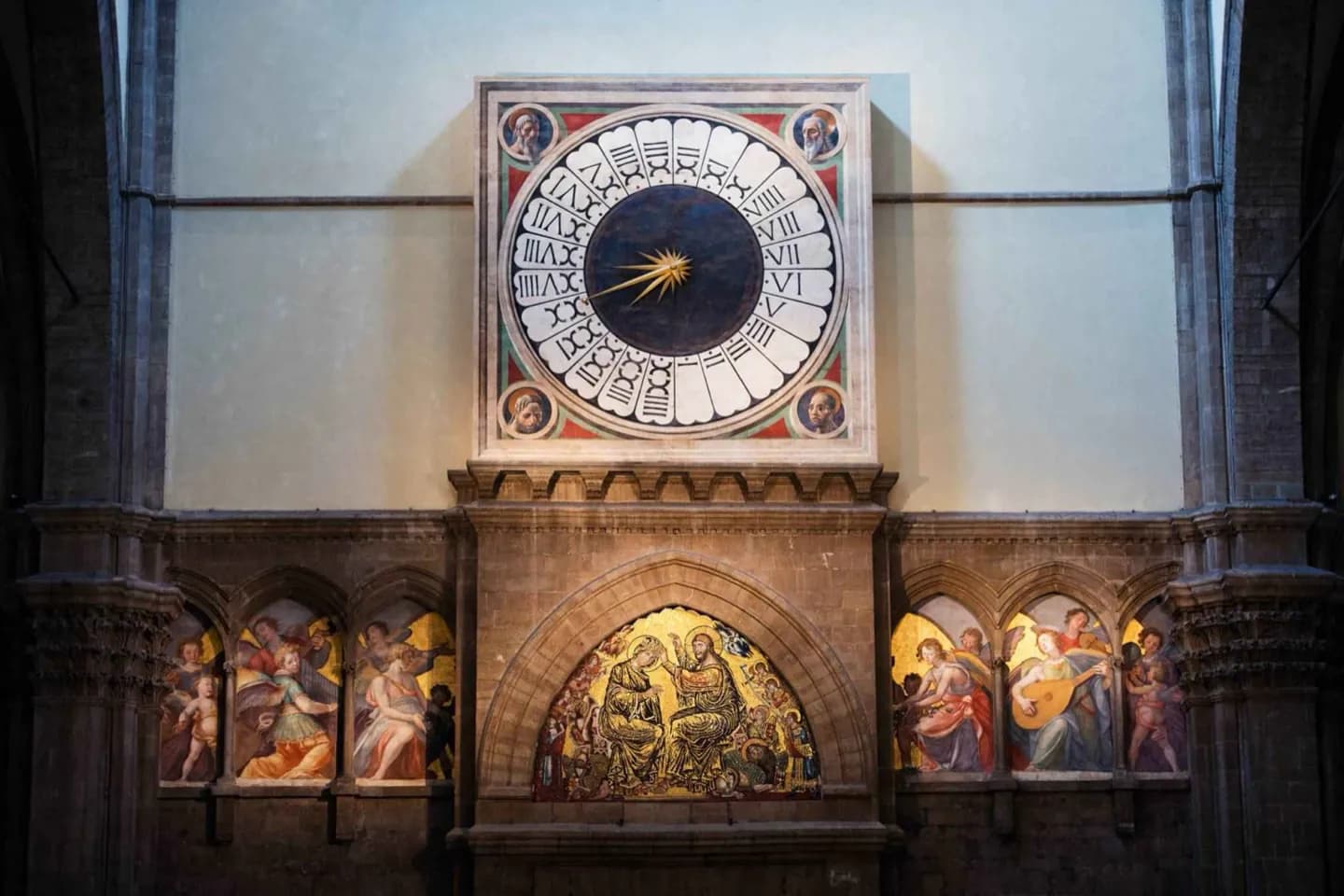
Why go
This small detail changes how the cathedral interior can be understood. In the late 15th century Paolo Toscanelli used an opening in the dome to project an image of the sun onto a meridian line. Later Leonardo Ximenes used the instrument in studies of the Earth's axial tilt. The cathedral was therefore not only a religious and civic monument, but also a working astronomical instrument.
The full story
Paolo Toscanelli installed a bronze globe with a small circular opening in the dome in the 15th century. It projected a reduced solar image onto the cathedral floor, allowing observations of solstices and the ecliptic. A marble marker in the chapel of the Croce records an observation from 1510. In 1754, the court astronomer Leonardo Ximenes used the instrument to investigate whether the Earth's axis changed over time. He also laid the bronze meridian line in the chapel floor. The instrument later became obsolete as more precise methods emerged and as temperature changes caused small movements in the dome. Its surviving traces add a scientific layer to a building usually approached through architecture and art. It also explains why astronomy appears in the cathedral's decorative and historical narrative.