
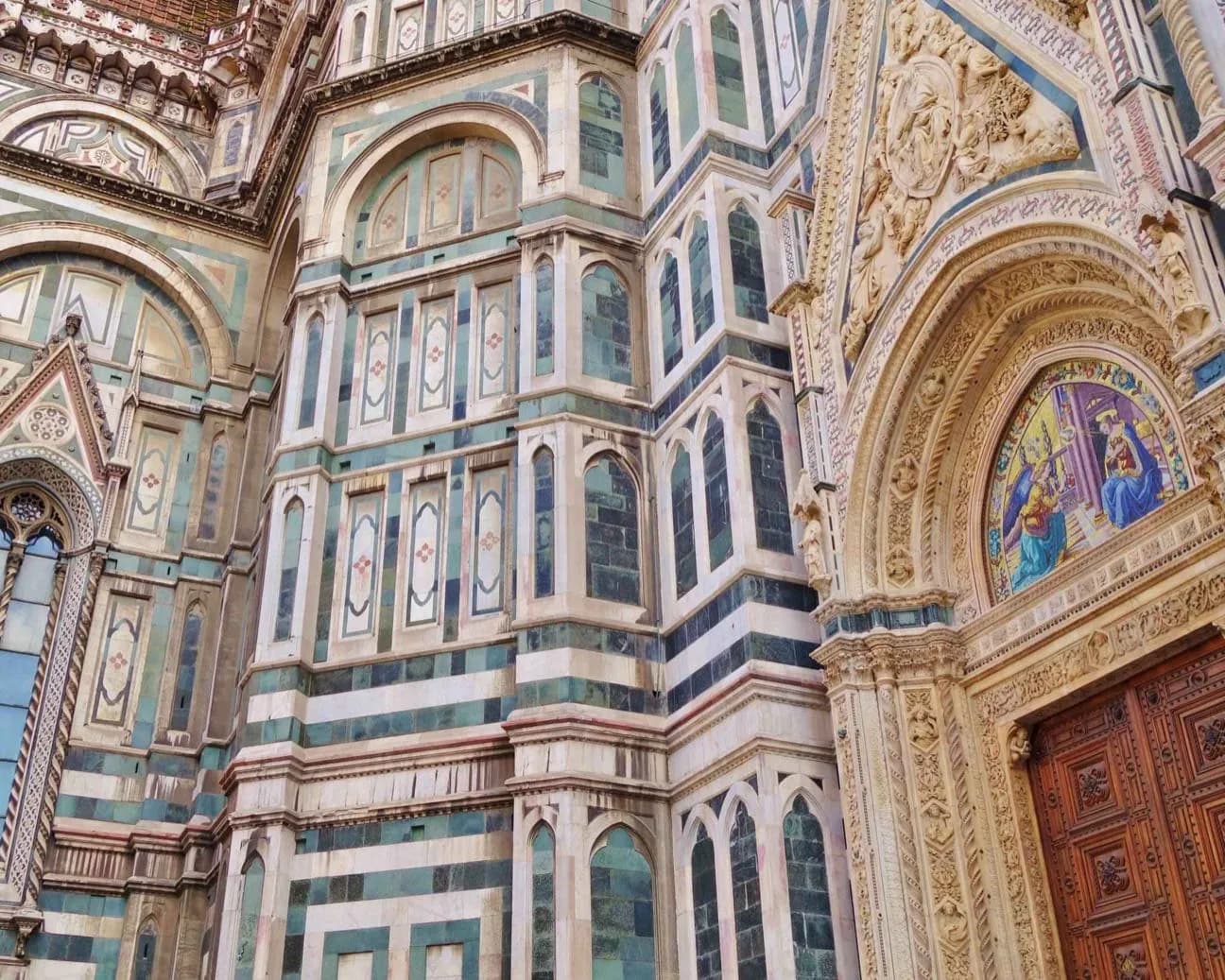
Why go
Brunelleschi matters because his ideas can be read in two nearby Florence landmarks. His dome solved the problem of spanning the unfinished cathedral without the conventional external buttresses, while his lost Baptistery panels used mirrors and geometry to test linear perspective. Together they show an architect working across construction, optics and the visual language that shaped Renaissance art.
The full story
By 1418, Santa Maria del Fiore still lacked its dome. The opening was intended to be larger than the Pantheon's, external buttresses were forbidden, and a conventional timber centering would have required an impractical amount of wood. Brunelleschi developed the solution that made the dome possible and became one of the defining figures of Renaissance architecture. His interest in geometry also changed painting. In perspective experiments based on the Baptistery, he asked viewers to compare a painted scene with its reflection in a mirror. The original panels have been lost, but the experiment helped establish linear perspective as a way of constructing pictorial space. His first major architectural commission, the Ospedale degli Innocenti, came through the silk guild in which he had trained as a goldsmith.