
Why go
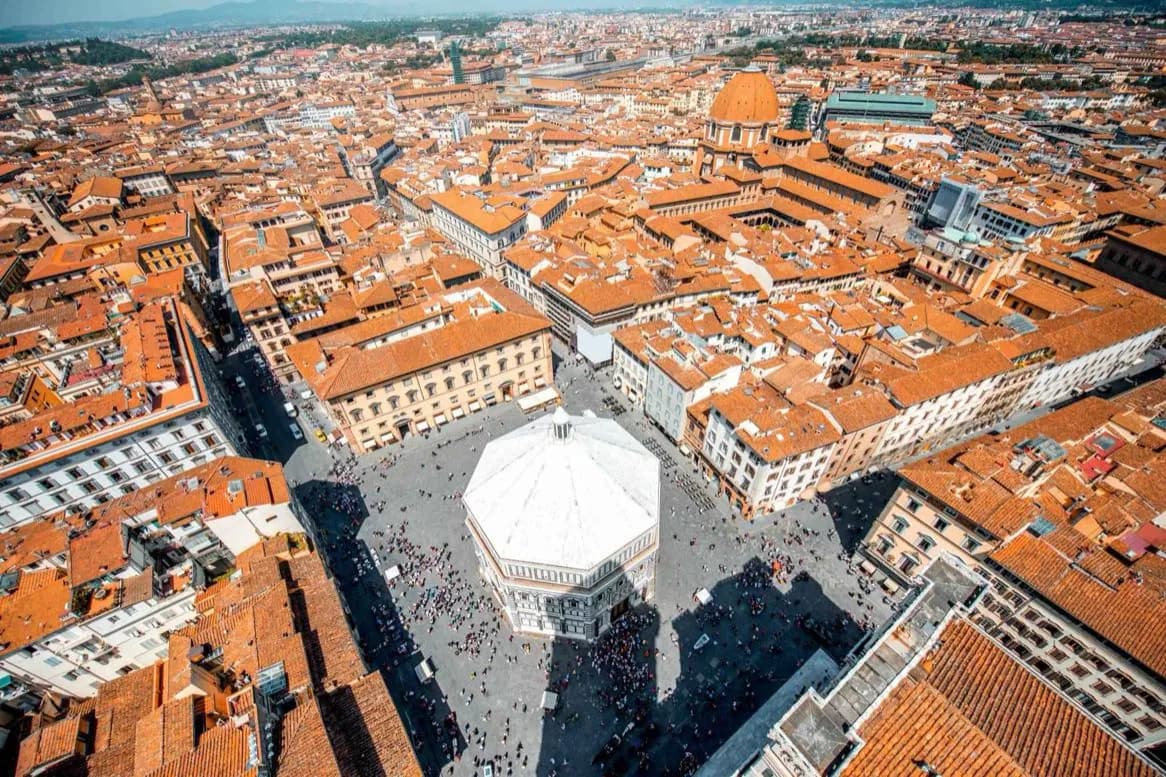
This history gives the building's layers a clear order. An early Christian baptistery stood here before the present Romanesque structure was completed in 1128. The porch and lantern followed, then the bronze doors of the 14th and 15th centuries. Look for the octagon, reused-looking granite pilasters and the lion heads beneath the roof as parts of that long remaking.
The full story
Medieval Florentines believed the Baptistery had been a temple to Mars, but later excavations found evidence of a Roman wall crossing the piazza rather than proof of that story. An earlier octagonal baptistery was already on the site by late antiquity. The present, larger building was rebuilt in the Romanesque period and reconsecrated in 1059; construction was complete by 1128. Its eight-sided plan was not simply decorative. In Christian tradition, eight signifies regeneration, fitting a building made for baptism. Around 1150, an octagonal lantern was added to the roof, and a porch changed the west side in 1202. Between the 14th and 16th centuries, three bronze doorways transformed the exterior into a public display of Florentine sculpture for the cathedral square.