
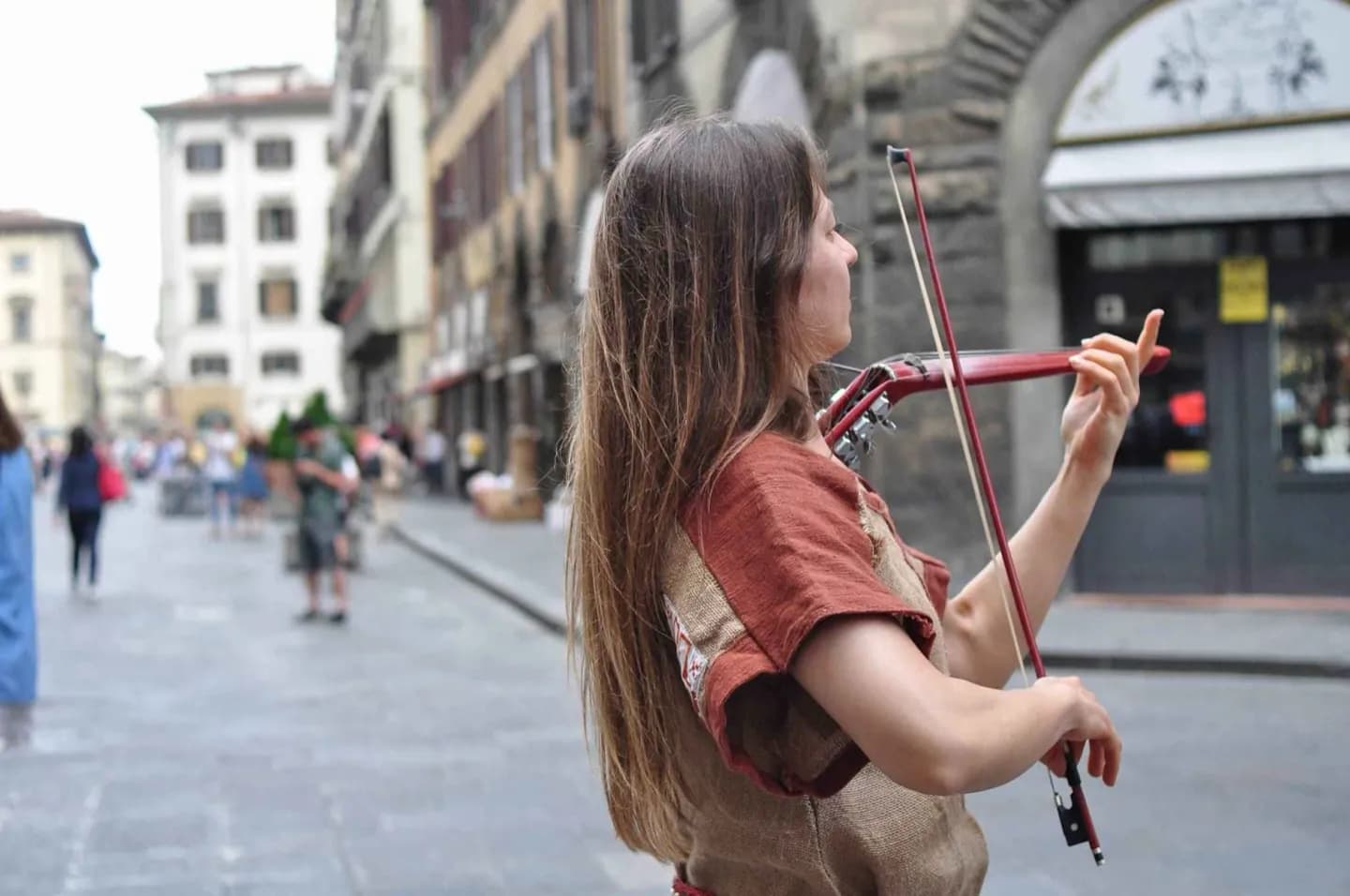
Why go
Music is an illuminating counterpoint to Florence’s visual arts. The city supported sacred singing, ceremonial wind players and later experiments that fed into opera. It helps visitors see Renaissance culture as a network of civic ritual, religious practice and learned debate rather than a story told only by paintings.
The full story
Florentine music developed through religious, civic and intellectual settings. In the 12th and 13th centuries, lay confraternities associated with mendicant orders sang laude, devotional songs in honour of the Virgin. These began as monophonic pieces, but paid singers and instrumentalists entered the tradition in the 14th and 15th centuries; by 1470 some companies maintained small choirs capable of polyphony. The city also employed wind players for public ceremonies, making music part of civic display. Renaissance humanists studied ancient Greek and Latin musical theory, including ideas of mode and harmony. Thinkers such as Marsilio Ficino connected musical harmony with the relationship between body, soul and cosmos. In the later 16th century, Florentine experiments with mythological drama helped open a path toward opera.
Useful to know
- Use this background when visiting churches or civic spaces: both were settings for performance as well as architecture and art.
- Look for current concert programmes separately; historic context does not indicate a regular performance schedule.