
Why go
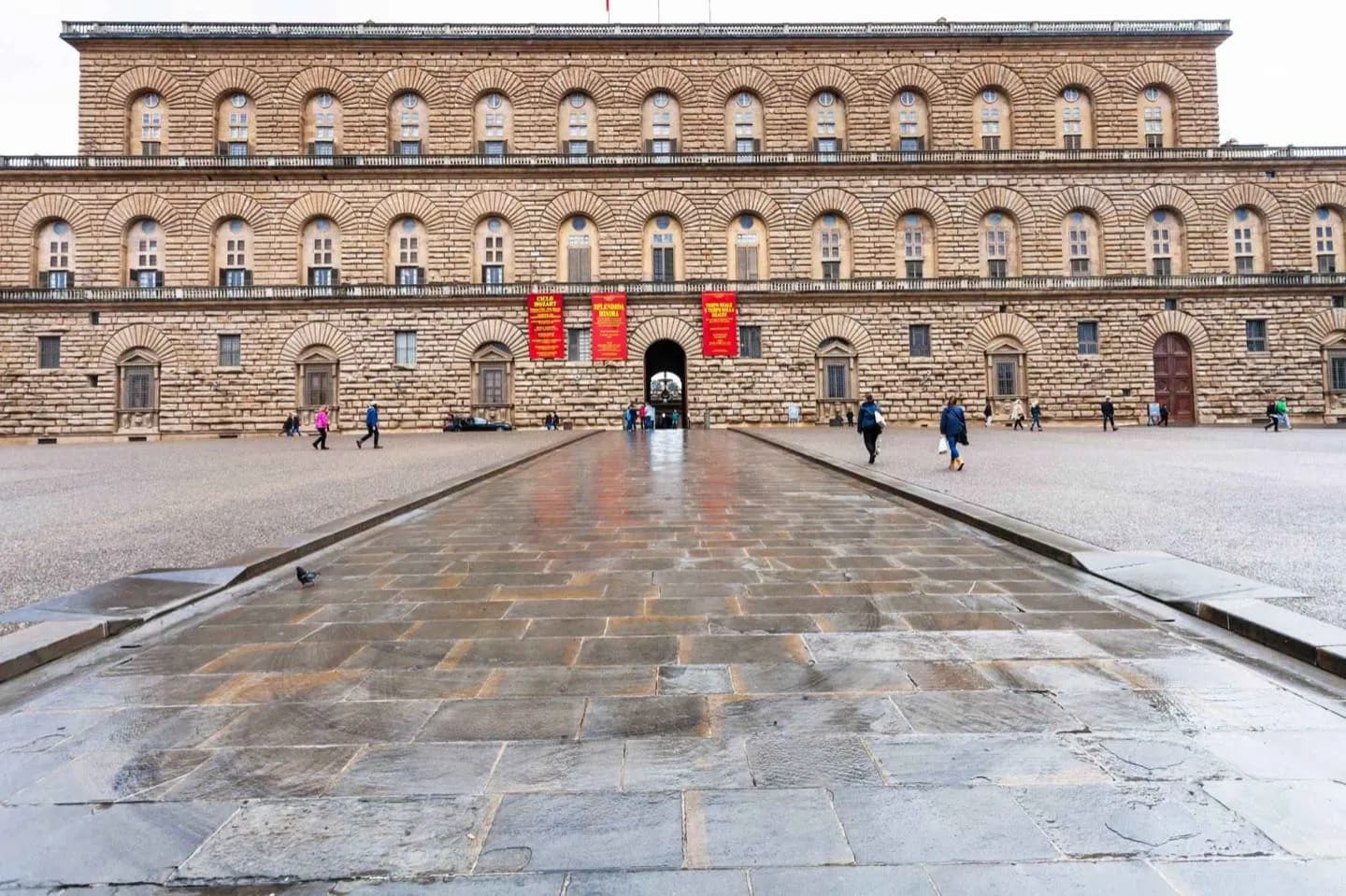
This background helps make sense of the palace's unusually forceful façade and its connection with Boboli. Luca Pitti commissioned the building in 1458, but its original architect remains uncertain; Luca Fancelli is generally credited rather than Brunelleschi. After the Medici acquired land on the Boboli hill, Niccolò Tribolo and then Bartolomeo Ammannati developed a formal garden around an amphitheatre, turning the residence into a larger courtly landscape.
The full story
Luca Pitti, a Florentine banker and supporter of Cosimo de' Medici, commissioned Palazzo Pitti in 1458. Its rusticated stonework and repeated arched openings create the severe, emphatic character that later additions continued. Giorgio Vasari associated the design with Brunelleschi, but the attribution is uncertain and Luca Fancelli is generally credited. Work stopped after Pitti's financial losses following Cosimo's death in 1464. The palace acquired a different scale under the Medici. Land behind it on the Boboli hill was assembled for a formal garden. Niccolò Tribolo began the design, and Bartolomeo Ammannati continued it after his death. The amphitheatre behind the main block became a court setting for staged performances, including Terence's Andria in 1476. The palace and gardens are therefore best read together: one presents a powerful urban façade, the other extends the residence into a designed hillside.