
Why go
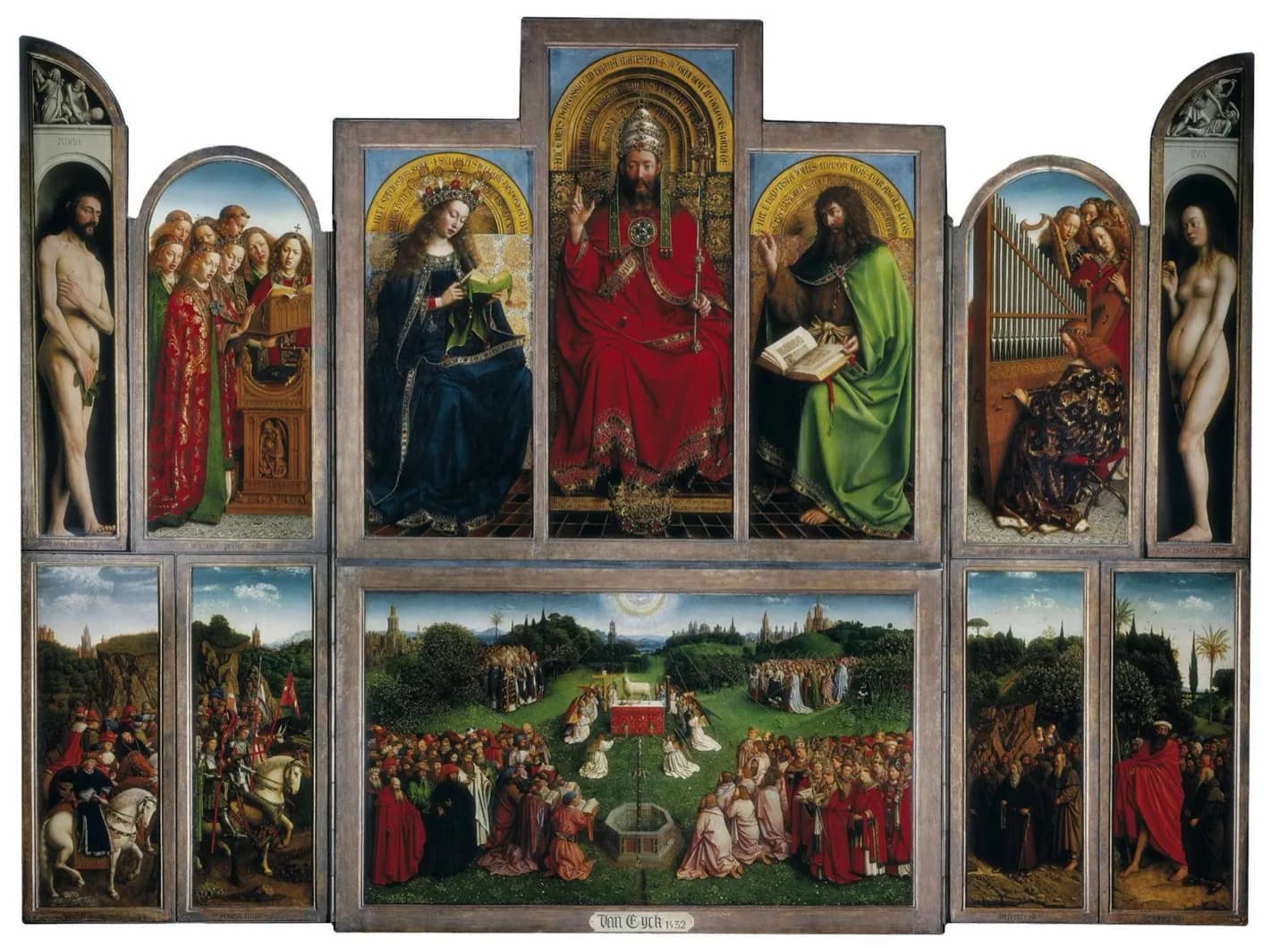
The altarpiece was made for a Ghent patron's chapel and remains tied to the city where it was installed in 1432. The hinged wings create distinct open and closed views; looking at the panels as a structure, then at the individual faces and landscapes, makes its scale and precision easier to grasp.
What to look for
- The hinged wings form different compositions when the altarpiece is open and closed.
- Gabriel and Mary occupy opposite sides of a single imagined room in the Annunciation panels.
- Saint Christopher appears among the pilgrims on an outer right-hand panel.
The full story
Jodocus Vijd and his wife commissioned the altarpiece for their chapel in the church that became St Bavo's Cathedral. Hubert van Eyck is associated with its design, and Jan van Eyck with much of the painting, though scholars have not convincingly divided every passage between the brothers. The work was installed in 1432. Its hinged shutters were designed to show different images when open and closed, making the act of viewing part of the work's original purpose. Look beyond the overall composition: the Annunciation spreads Gabriel and Mary across facing panels, while individual pilgrims and hermits receive unusually close attention. Such observed faces, plants and textures help explain why the painting marked a shift from idealized medieval images toward a more exact account of the visible world. The panel painting also carries a specifically Ghent story: it was made for a chapel here, rather than brought in later as a detached museum object.
Useful to know
- Visit St Bavo's Cathedral as the setting, then give the altarpiece separate viewing time rather than treating it as a passing detail.
- Check the cathedral's official visitor information for current access to the artwork and any ticketed areas.