
Why go
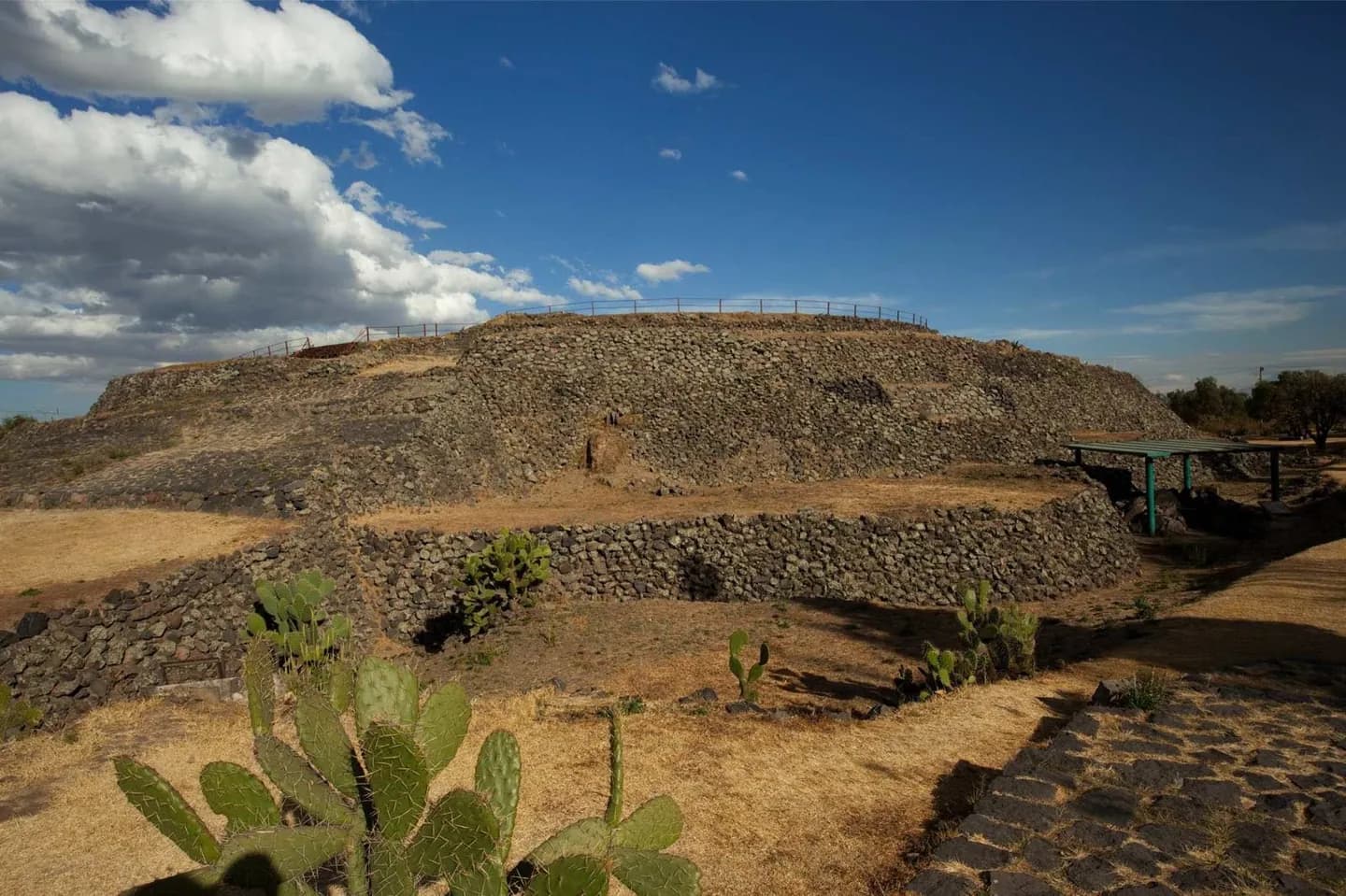
site that was occupied during the Mesoamerican Middle and Late Formative (ca. 700 B.C. to A.D. 150). Based on its date of occupation, Cuicuilco may be the oldest city in the Valley of Mexico and was roughly contemporary with, and possibly interacting with the Olmec of the Gulf Coast of lowland Veracruz and Tabasco. Archaeological site The site.
What to look for
- Notice how Cuicuilco relates to the surrounding streets and skyline.
- Look for surviving details that reveal the site's principal historical layer.
The full story
of Cuicuilco is covered by a dense volcanic lava field known as the Pedregal de San Ángel. The lava covers an area of approximately 80 km², including the foothills of the Ajusco mountain range and extending down to a nearby lake shore. A 1956 study concluded that the uneven lava deposits, reaching a depth over 10 m in areas, were a major factor in the preservation of Cuicuilco. The site is also inside a modern urban area, and is partially covered by buildings associated with the National University of Mexico. Only partial archaeological investigation has been possible, and modern building techniques have damaged the prehistoric city. Several 1990 archaeological finds at Cuicuilco, consisting of a circular pyramid constructed within a plaza with smaller structures associated with agricultural system, were destroyed for the construction of a multi-storied office complex. Consequently, the true size and complexity of Cuicuilco may be difficult to ascertain. Frida Kahlo Museum belongs to the layered story of the Valley of Mexico. Its architecture, landscape, collections, or civic.
Useful to know
- Allow enough time to see Cuicuilco and its immediate setting without rushing.
- Check current official access information before entering any managed interior.
Your next visit
Estimated · Declared scenario and planning estimates; no live opening, weather, queue or booking service.
Outdoor visit · 30–45 min
World planning estimate; admission, opening, visit duration and access need checking.