
Why go
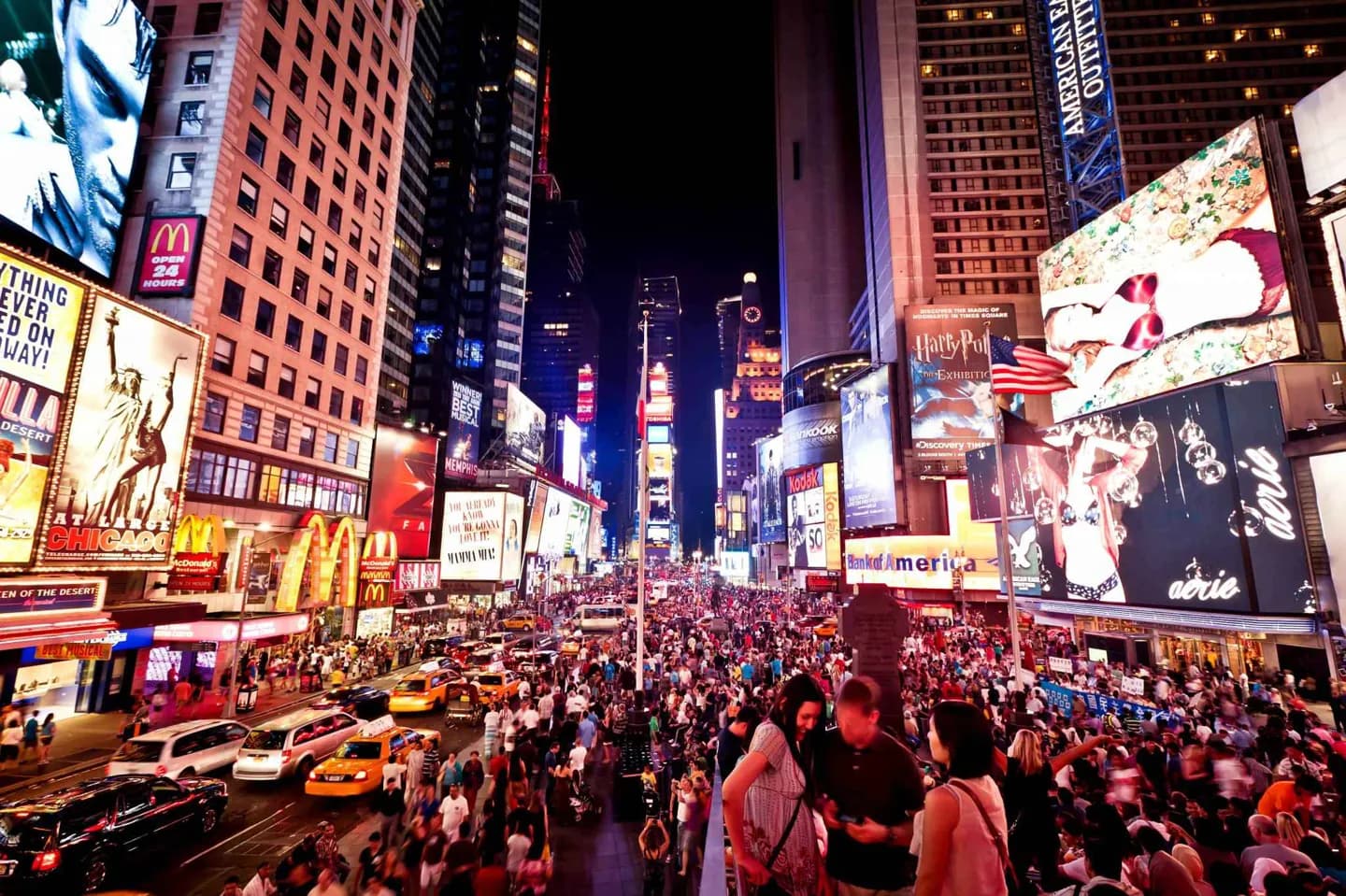
The junction of Broadway and Seventh Avenue creates a distinctive bowtie-shaped space rather than a conventional square. Its billboards and theater connections explain much of the attraction: this is a place to observe the city’s entertainment frontage at street level. A brief pause can capture that experience without treating the whole district as one attraction.
What to look for
- The Broadway pedestrian plazas extend from 41st to 47th Streets.
- Duffy Square occupies the northern triangle of the broader junction.
- Billboards cover the buildings around the Broadway and Seventh Avenue meeting point.
The full story
The name Times Square dates to 1904, when The New York Times moved into its new building here. Before that it was Longacre Square, a name connected with the carriage trade and borrowed from London’s Long Acre. The change marks a shift from a neighborhood shaped by horses and vehicles to one associated with newspapers, electric light and entertainment. The annual New Year’s Eve ball drop began in 1907 at the Times Building, extending that association into a recurring public ritual. Broadway theaters had already drawn audiences north as the city expanded. The junction’s unusual geometry helped concentrate that activity into two triangular spaces around 45th Street. Duffy Square’s memorials add another layer: the northern triangle honors chaplain Francis P. Duffy and also contains a statue of theater figure George M. Cohan.
Useful to know
- Use the pedestrian plazas to stop and look rather than standing in moving foot traffic.
- Combine the junction with a theater visit if Broadway is the main interest.
Your next visit
Estimated · Declared scenario and planning estimates; no live opening, weather, queue or booking service.
Outdoor visit · 15–25 min
World planning estimate; admission, opening, visit duration and access need checking.