
Why go
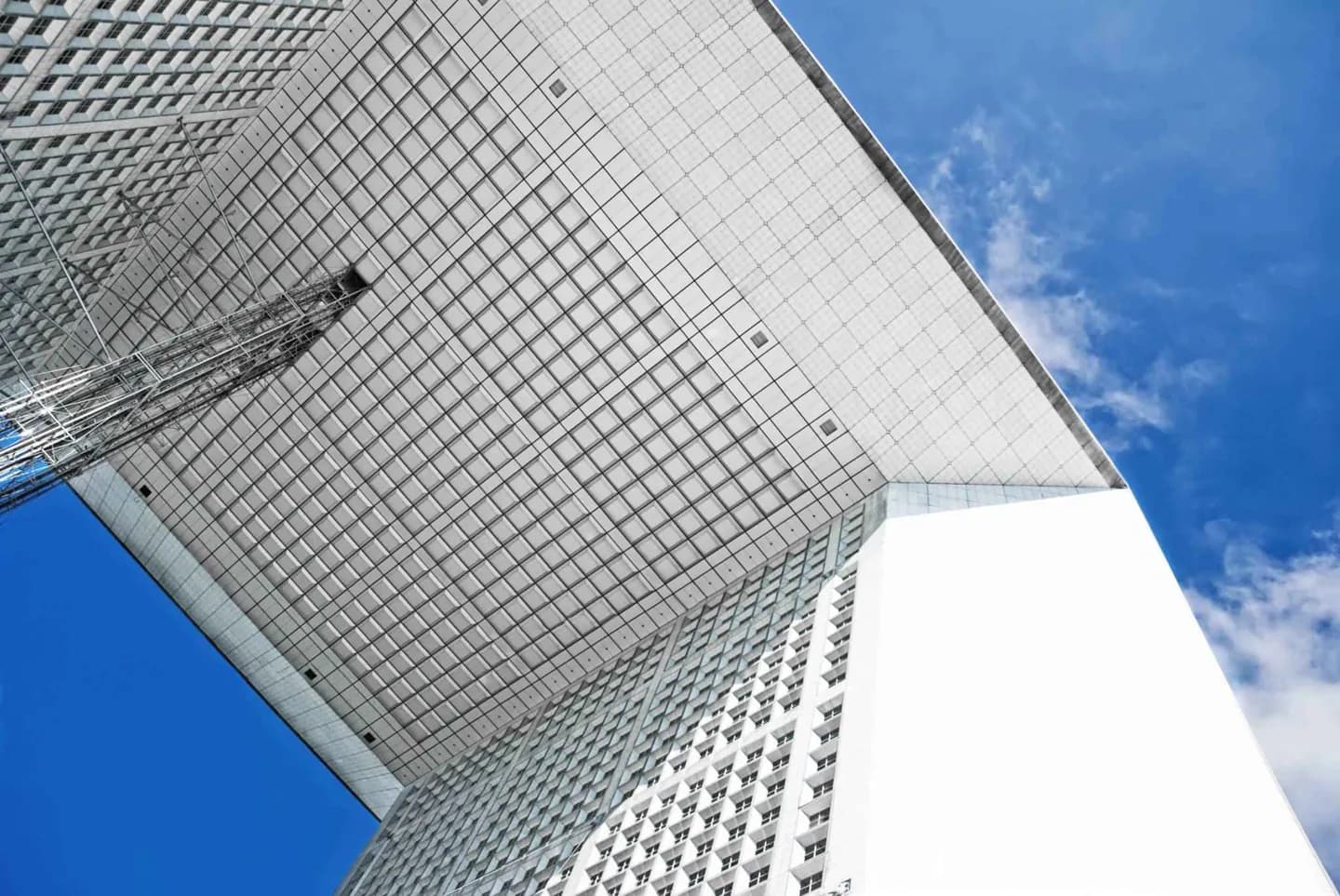
Grande Arche translates the triumphal-arch idea into late twentieth-century architecture. Its immense void frames sky and distant city rather than celebrating a military victory. A slight turn from the historic axis reveals the technical constraints below, while the surrounding towers show how the monument anchors an entirely modern district.
What to look for
- The near-cubic structure forms a vast rectangular opening above the parvis.
- Its alignment extends the Louvre–Tuileries–Champs-Élysées historic axis westward.
- A slight rotation accommodates transport infrastructure and foundations below.
The full story
President François Mitterrand launched an international competition for a new monument at La Défense in 1982. Danish architect Johann Otto von Spreckelsen and engineer Erik Reitzel won with a design conceived as a modern counterpart to the Arc de Triomphe, dedicated to humanity rather than military victory. Construction began in 1985, and French architect Paul Andreu took over architectural responsibility after Spreckelsen resigned. The Grande Arche opened in 1989 during the bicentenary of the French Revolution. Its concrete frame, glass and pale cladding form an approximately 110-metre cube around a huge central void. The building is rotated slightly because Métro, RER and road infrastructure beneath the site constrained its foundations. That practical adjustment also intensifies the perspective along Paris’s historic axis and makes the arch’s depth visible from the parvis.
Useful to know
- Plan for an exterior visit from the pedestrian parvis; do not assume roof or interior access.
- Walk back along the esplanade to compare the arch with the Arc de Triomphe in the distance.
Your next visit
Estimated · Declared scenario and planning estimates; no live opening, weather, queue or booking service.
Outdoor visit · 30–45 min
World planning estimate; admission, opening, visit duration and access need checking.