
Why go
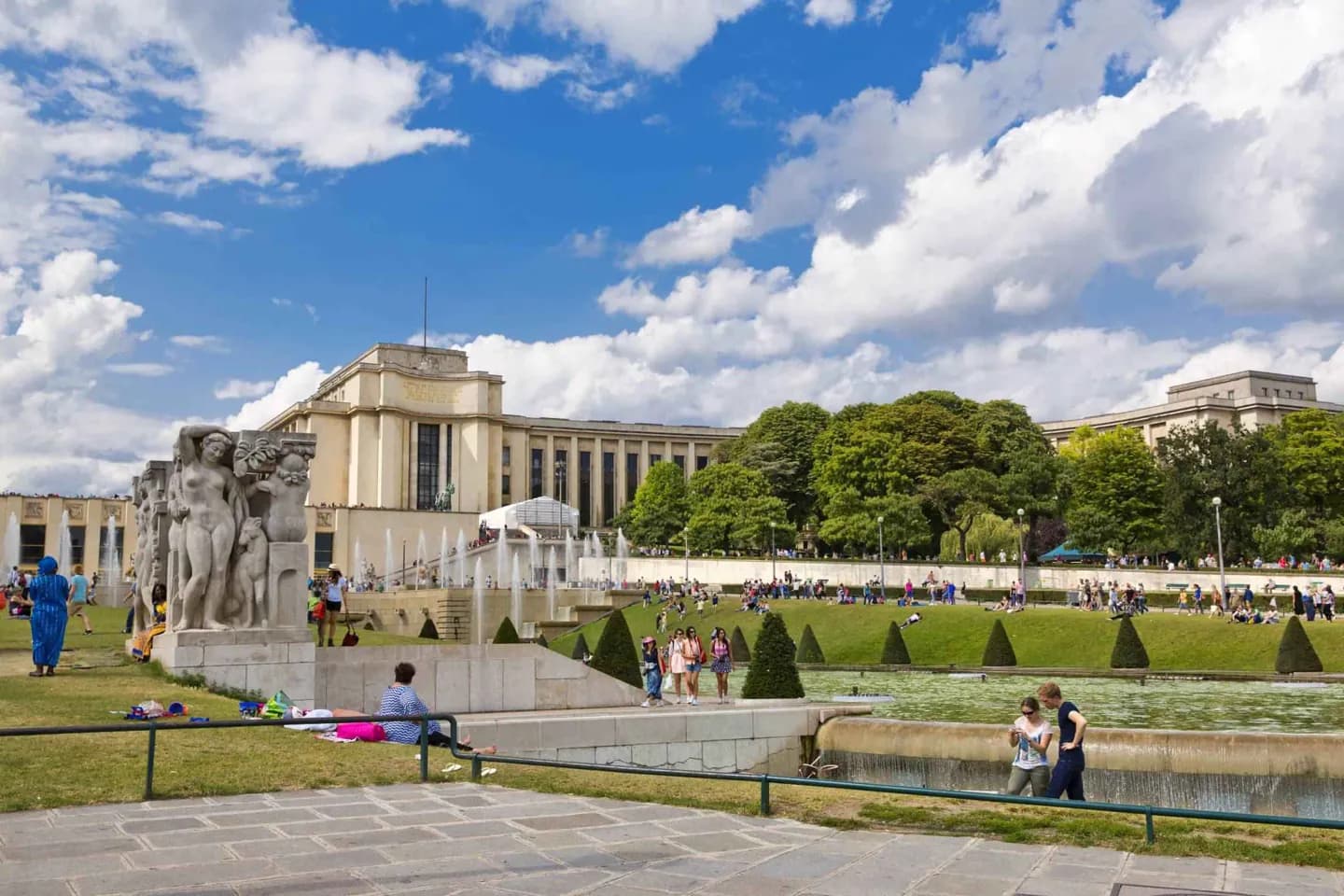
Chaillot turns the Eiffel Tower panorama into a deliberate architectural composition. The broad central gap, independent wings and gilded terrace figures reward attention even without entering a museum. It also carries civic weight: the United Nations General Assembly adopted the Universal Declaration of Human Rights here in 1948.
What to look for
- Paul Valéry quotations and sculptural groups decorate the two curved wings.
- Eight gilded figures line the terrace facing the Eiffel Tower.
- A commemorative stone recalls the 1948 adoption of the Universal Declaration of Human Rights.
The full story
The Palais de Chaillot replaced the earlier Palais du Trocadéro for the 1937 International Exposition. Architects Louis-Hippolyte Boileau, Jacques Carlu and Léon Azéma reused the earlier foundations but separated the new wings, leaving the centre open toward the Eiffel Tower. That void became the defining gesture: the palace acts as a frame rather than a backdrop. Sculptural groups crown the buildings, Paul Valéry quotations run across their surfaces, and eight gilded figures stand along the terrace. The complex later acquired significance beyond the exhibition. The United Nations General Assembly adopted the Universal Declaration of Human Rights here on 10 December 1948, an event commemorated on the terrace now known as the Esplanade des droits de l’homme. The wings contain several museums and the Théâtre national de Chaillot, each operated as a separate destination.
Useful to know
- Treat the terrace and exterior as one visit; check each museum or theatre separately before adding an indoor stop.
- Continue downhill through the Jardins du Trocadéro for changing views toward Pont d’Iéna.
Your next visit
Estimated · Declared scenario and planning estimates; no live opening, weather, queue or booking service.
Outdoor visit · 30–45 min
World planning estimate; admission, opening, visit duration and access need checking.