
Why go
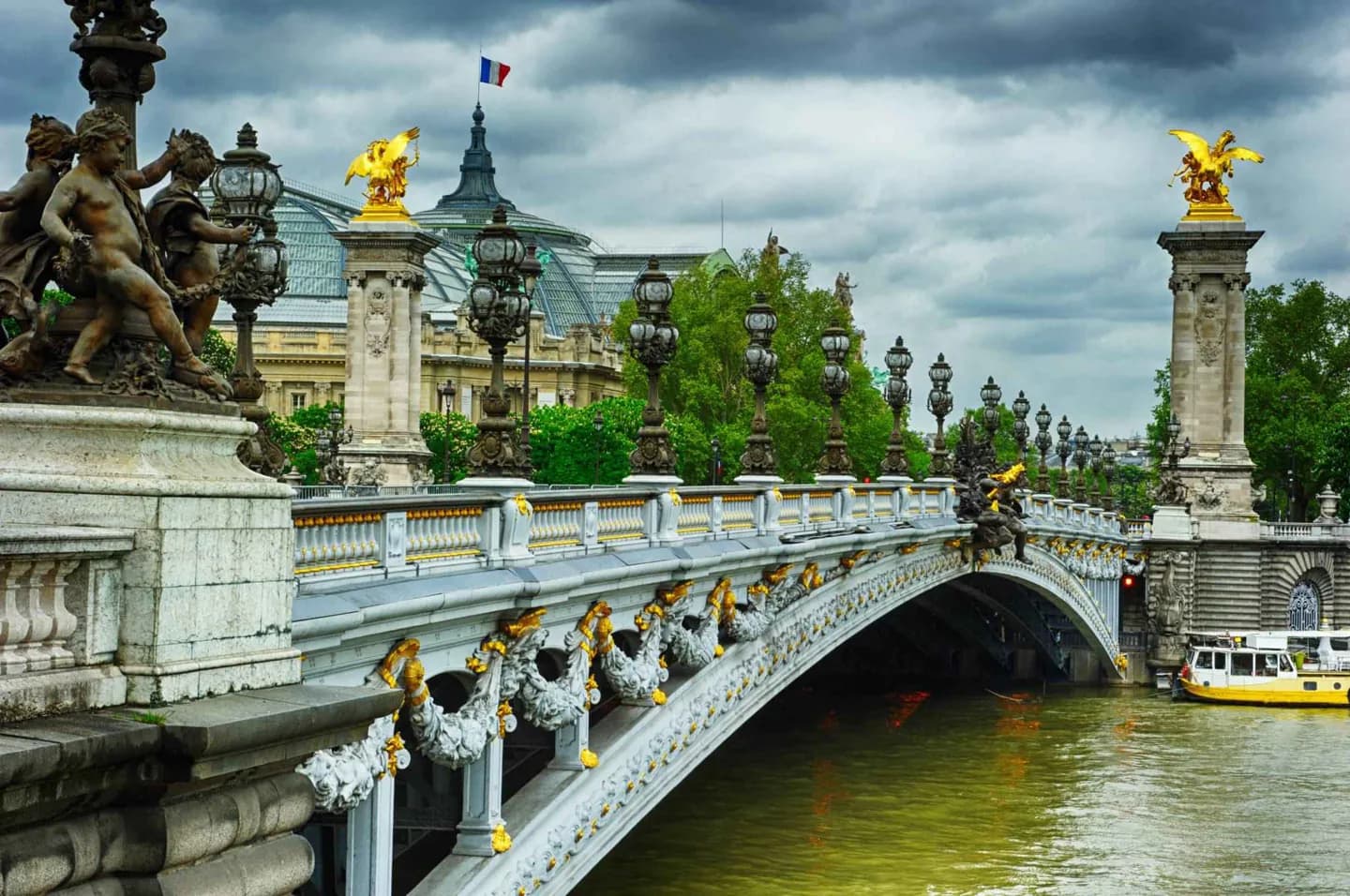
This bridge is more than a connection across the Seine. Its low single-arch profile was designed to preserve views between Les Invalides, the Champs-Élysées and the exhibition buildings on the right bank, while lamps, nymphs, lions and gilded figures reward a closer look. It is an easy addition to a walk through the 7th and 8th arrondissements.
What to look for
- Four gilt-bronze Fames with Pegasus crown the bridge's massive masonry supports.
- Nymph reliefs of the Seine and Neva commemorate the Franco-Russian Alliance.
- The steel arch was kept low to protect the views toward Invalides and the Champs-Élysées.
The full story
Pont Alexandre III was built from 1896 to 1900 for the Exposition Universelle, alongside the nearby Grand Palais and Petit Palais. It is named for Tsar Alexander III after the Franco-Russian Alliance of 1892; his son Nicholas II laid its foundation stone in 1896. The designers, Joseph Cassien-Bernard and Gaston Cousin, worked under a key urban constraint: the bridge could not obstruct the ceremonial views toward Les Invalides or the Champs-Élysées. Engineers Jean Résal and Amédée d'Alby solved that problem with a low, single-span steel arch. The decoration turns that engineering decision into a public spectacle. Gilded Fames rise above the supports, while lamps, cherubs, nymphs and winged horses connect the bridge's Beaux-Arts form to the exhibition architecture on the right bank. At the centre, the paired reliefs of the Seine and Neva make the alliance visible in hammered copper.
Useful to know
- Cross on foot between Les Invalides and the Grand Palais or Petit Palais.
- Pause at both ends to see how the bridge aligns the Seine with the surrounding monuments.
- Allow extra time in wet weather, when the open bridge is less comfortable for lingering.
Your next visit
Estimated · Declared scenario and planning estimates; no live opening, weather, queue or booking service.
Outdoor visit · 30–45 min
World planning estimate; admission, opening, visit duration and access need checking.