
Why go
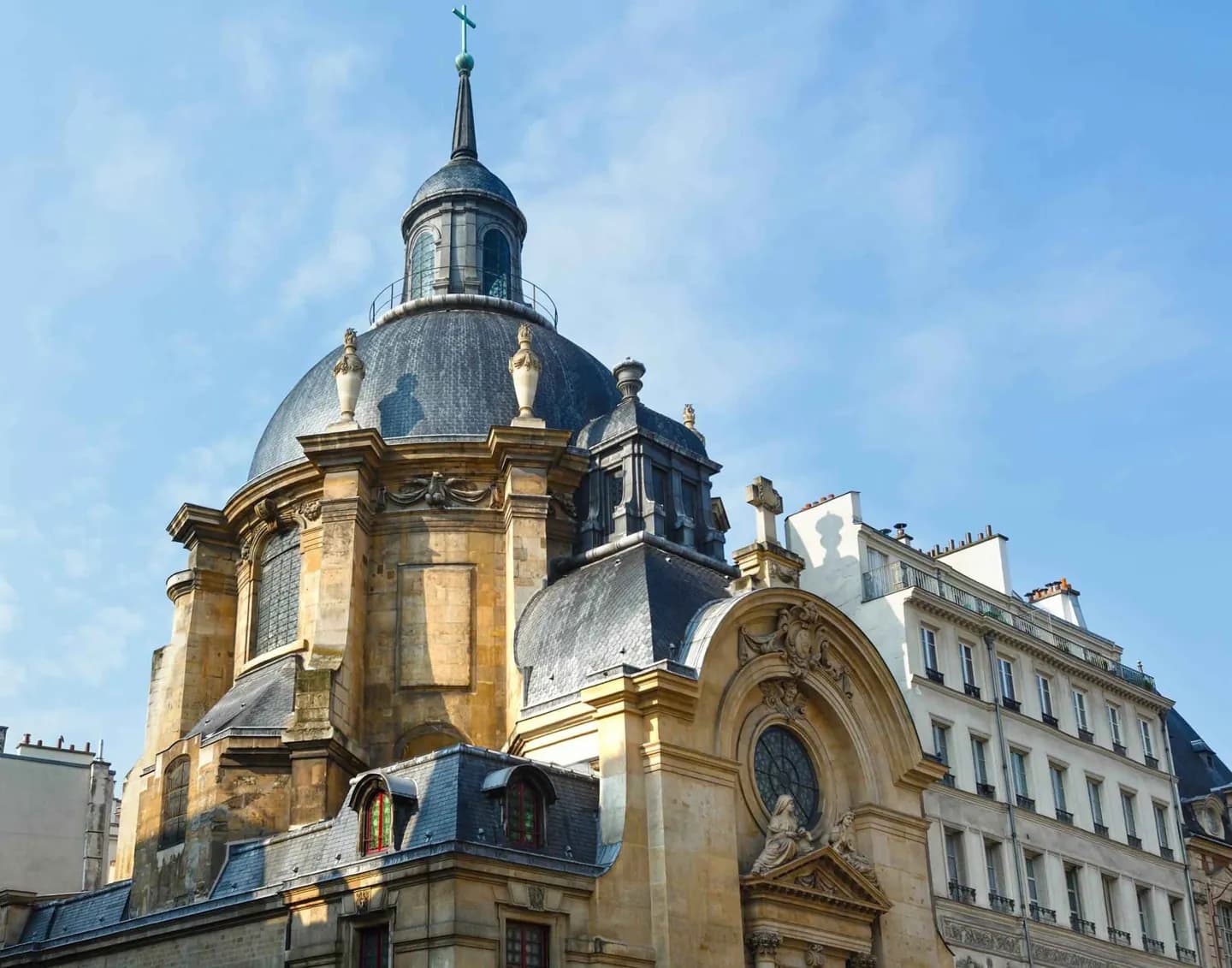
The building compresses a complex religious history into an inventive Baroque plan. A domed central space, subsidiary chapels and a theatrical street façade began as a Visitation convent church. After the Revolution, the chapel became a Protestant place of worship, preserving the architecture while changing its community and meaning.
What to look for
- The imperial dome rises above a compact centralized plan by François Mansart.
- A curved Baroque façade, lantern and spire draw the eye upward from Rue Saint-Antoine.
- The former convent chapel retains traces of both Catholic and Protestant history.
The full story
The Order of the Visitation established a Paris convent in 1619 and commissioned François Mansart to design its church in the 1630s. Mansart arranged eight subsidiary spaces around a domed centre, creating a compact and influential Baroque plan. The exterior combines a strongly modeled portal, curved roof, lantern and spire. Saint Vincent de Paul served as spiritual director to the convent, and the crypt became associated with Nicolas Fouquet’s family. The Revolution dissolved the convent, expelled the sisters and left the chapel in secular use while most surrounding buildings disappeared. After the Concordat of 1801, the state assigned the surviving church to Reformed Protestants, who had faced severe restrictions since the revocation of the Edict of Nantes. The congregation continues to worship here, giving the monument a living function rather than a purely historic one.
Useful to know
- Consult the congregation’s official calendar; entry is tied to services, concerts and announced events.
- Respect worship activity and avoid treating an open service as a general sightseeing session.
Your next visit
Estimated · Declared scenario and planning estimates; no live opening, weather, queue or booking service.
Outdoor visit · 30–45 min
World planning estimate; admission, opening, visit duration and access need checking.