
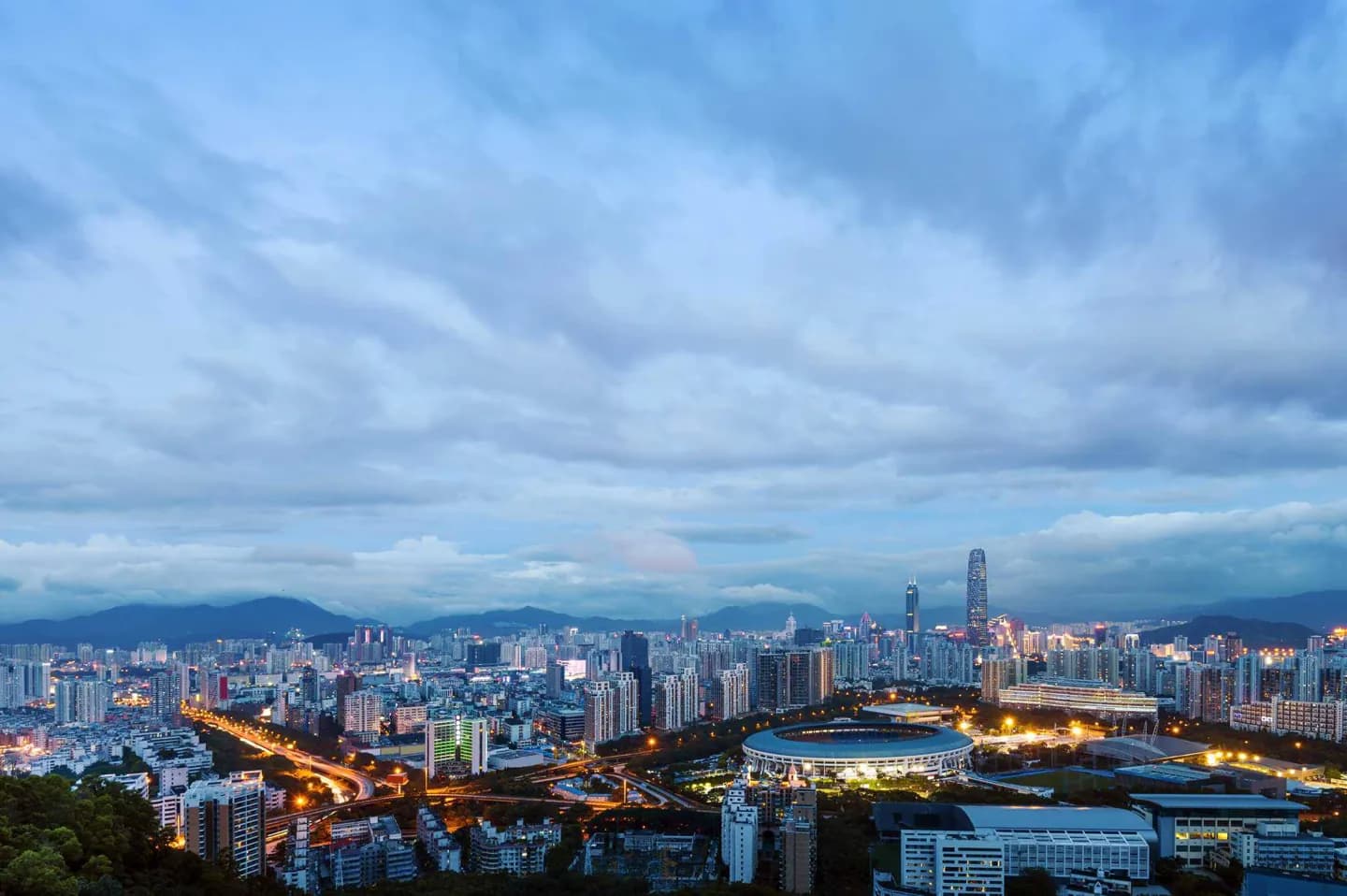
Why go
The city’s modern form reflects economic reforms and investment that began around 1980, with Hong Kong close to its southern edge. A walk through Futian, Huaqiangbei or Shekou shows different outcomes of that growth: civic buildings, electronics trade and waterfront development.
The full story
Shenzhen lies in Guangdong immediately north of Hong Kong. In the late 1970s and early 1980s, China chose the area for a Special Economic Zone, where new approaches to investment and enterprise could be tried. Its position beside Hong Kong gave the experiment access to capital, management experience and cross-border connections. Rapid industrial and urban growth followed. The city that resulted is not one uniform skyline: Futian became a civic and business centre, Huaqiangbei developed a dense electronics trade, and Shekou grew around port and waterfront activity. Shenzhen’s stock exchange and technology companies reflect its later role beyond manufacturing. Older descriptions of a single fishing village flatten this more varied history. Seeing two or three districts makes the change easier to understand than any one tower view.
Useful to know
- Compare central Futian with Huaqiangbei or Shekou to see different parts of the city’s growth.