
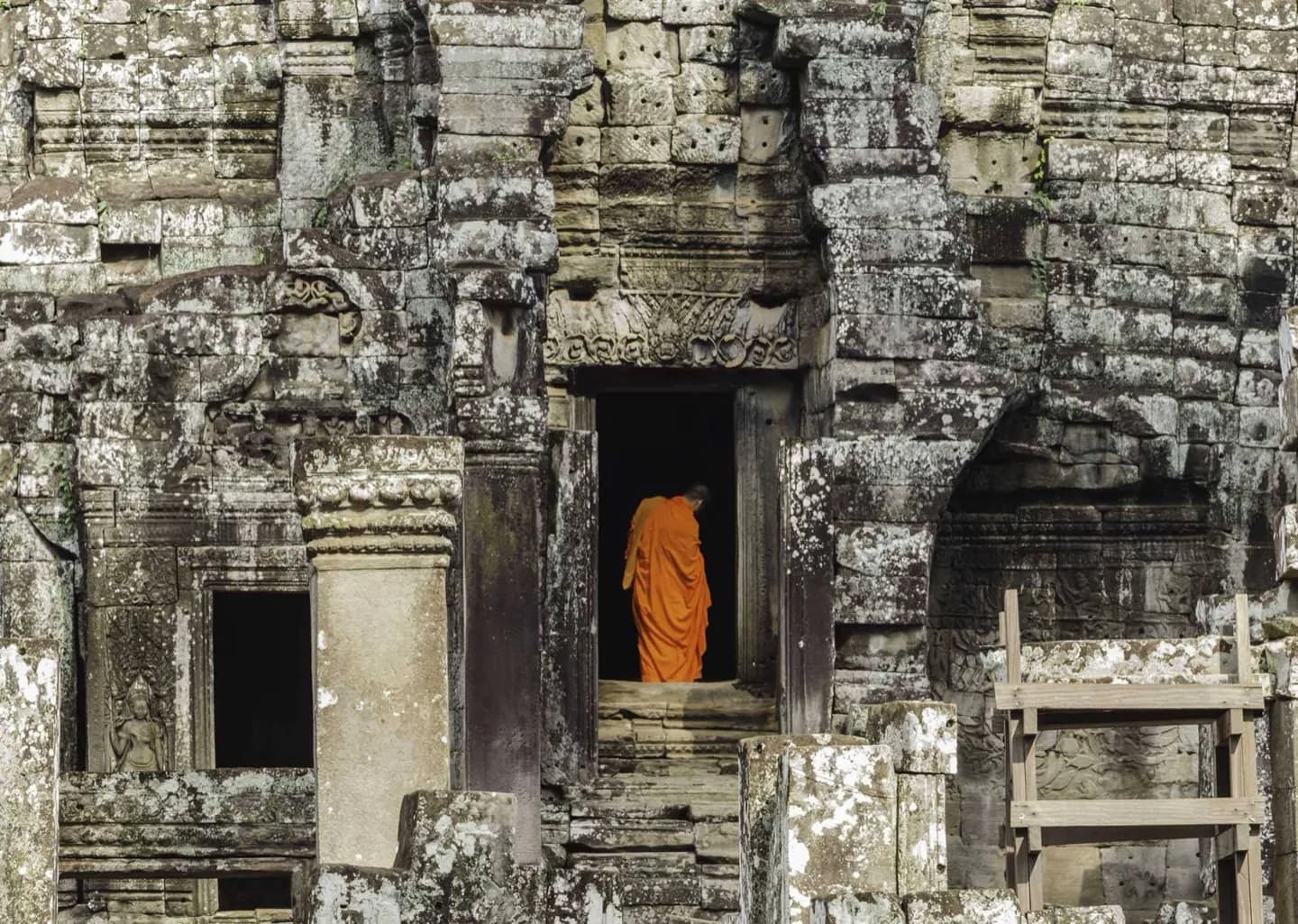
Why go
Built for King Suryavarman II in the twelfth century, Angkor Wat joined a temple-mountain plan to long, raised galleries. It was dedicated to Vishnu and later became a Buddhist place of worship. Its bas-reliefs and devata figures offer close detail after the first impression of its silhouette. Give both the overall plan and the carvings attention.
What to look for
- The moat and outer wall frame a long approach to the central towers.
- Three rectangular galleries rise toward a group of five towers.
- Bas-reliefs and devata figures reward a slower look along the walls.
The full story
King Suryavarman II built Angkor Wat in the early twelfth century as a state temple dedicated to Vishnu. Its design combines a temple mountain with enclosing galleries. The moat, walls and towers evoke an ordered world associated with Mount Meru in Hindu tradition. Angkor Wat faces west, unlike many other Angkorian temples. The reason remains debated, so notice how it shapes your approach rather than accepting one explanation. The temple later became a Buddhist place of worship and has retained religious meaning as well as architectural importance. Once inside, look beyond the familiar outline of the towers. Long bas-reliefs turn the galleries into places for sustained viewing, and devata figures punctuate the walls. Moving from the broad approach to these close carvings is part of the experience.
Useful to know
- Allow time to move through the successive galleries, not just photograph the front view.
- Look at the carved walls after taking in the overall plan; their detail is easy to miss on a quick pass.