
Why go
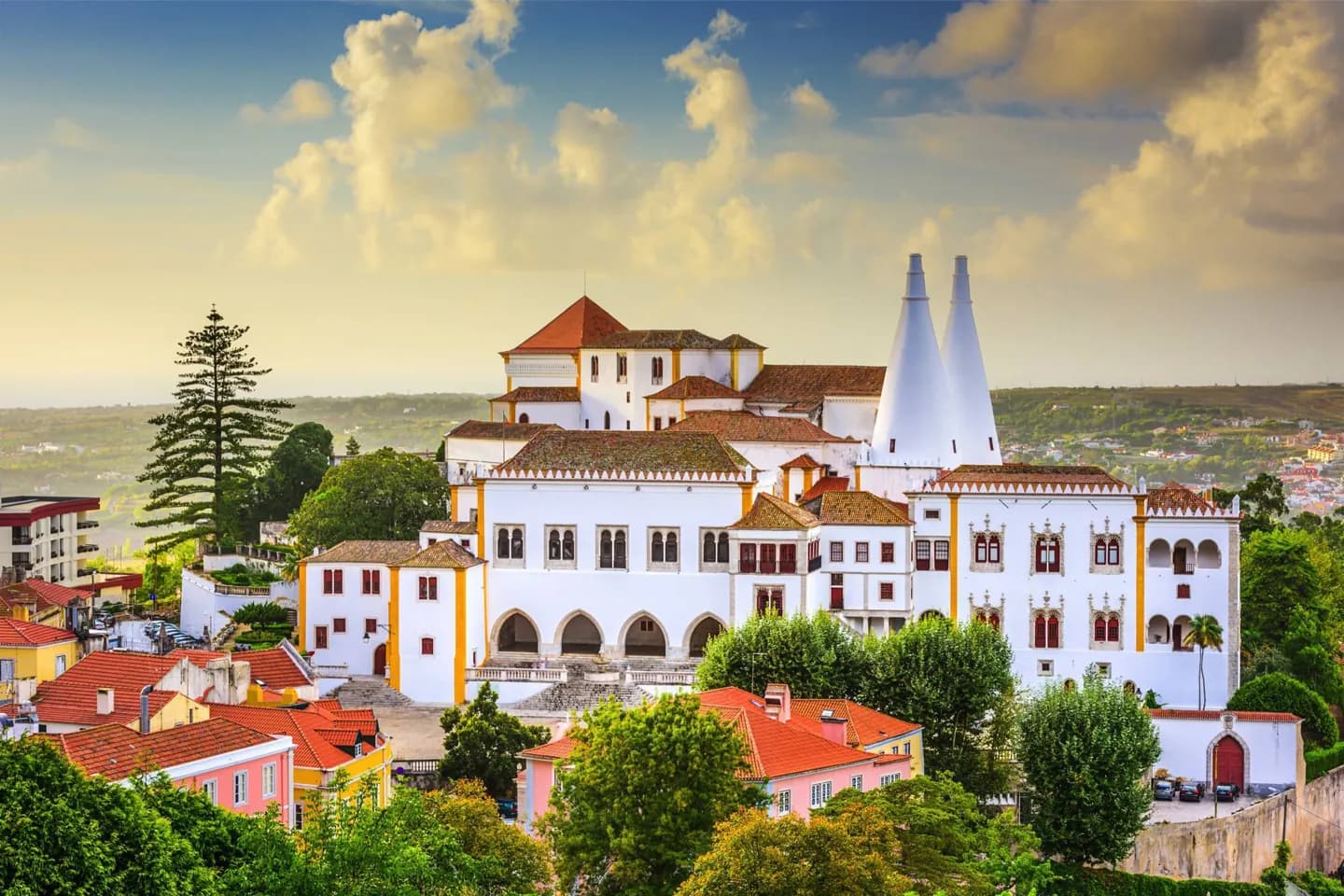
This is the place to understand Sintra as a lived-in royal town. Its conical kitchen chimneys, Swans’ and Magpies’ rooms and Seville-made tiles give specific clues to how the palace changed under different monarchs. The close relationship with the town contrasts with Pena’s more remote mountain setting.
The full story
Sintra National Palace, also known as Palácio da Vila, occupies the town rather than a remote hilltop. Its history reaches back to an Islamic-period residence below the Castle of the Moors, but no fabric from that period survives. The earliest surviving part may be the Royal Chapel from the time of King Dinis. A major campaign under João I, beginning around 1415, shaped much of the central court and façade. The distinctive conical kitchen chimneys belong to this long-lived complex. Rooms named for painted ceiling birds—the Swans’ Room and Magpies’ Room—turn decoration into clues about court culture; the magpie story involving João I is a tradition best read as such. Manuel I later remade parts of the palace and brought in coloured tiles made in Seville, many with Islamic motifs. Gothic, Manueline and Mudéjar references now coexist. The palace was used by Portuguese rulers across centuries, making its layered rooms a compact history of Sintra’s royal life.