
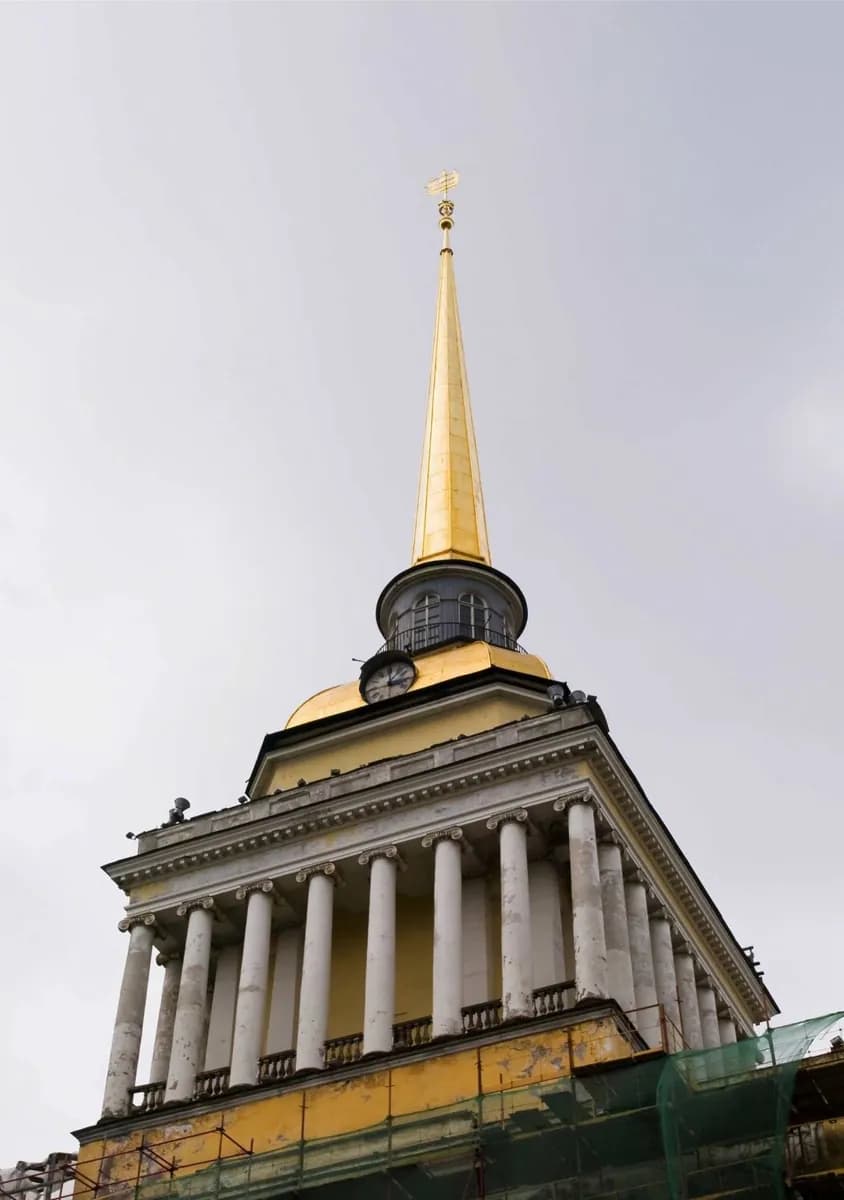
Why go
Russian Admiralty rewards attention to scale, orientation, and setting. Admiralty Board (Адмиралтейств-коллегия) was a supreme body for the administration of the Imperial Russian Navy in the Russian Empire, established by Peter the Great on December 12, 1718. Before leaving, compare one close detail of Russian Admiralty with its broadest public view.
What to look for
- Russian Admiralty: Observe how the monument announces itself from the approach.
- Russian Admiralty: Contrast its largest forms with the smallest visible ornament.
- Russian Admiralty: Walk beyond the centerline for a more revealing perspective.
The full story
Admiralty Board (Адмиралтейств-коллегия) was a supreme body for the administration of the Imperial Russian Navy in the Russian Empire, established by Peter the Great on December 12, 1718. The responsibilities of the Admiralty Board had been changing throughout its history. It supervised the construction of military ships, ports, harbors, and canals and administered Admiralty Shipyard. The Admiralty Board was also in charge of naval armaments and equipment, preparation of naval officers etc. In 1802, the Admiralty Board became a part of the Ministry of the Navy. Along with the Admiralty Board, there was also the Admiralty Department in 1805-1827 with the responsibilities of the Chief Office of the Ministry. In 1827, the Admiralty Board was turned into the Admiralty Council (Адмиралтейств-совет), which would exist until the October Revolution of 1917. Admiralty building The Admiralty Board used to be headquartered in the Admiralty building in Saint Petersburg.
Useful to know
- Plan Russian Admiralty mainly as an exterior stop unless current visitor access is confirmed.
Your next visit
Estimated · Declared scenario and planning estimates; no live opening, weather, queue or booking service.
Outdoor visit · 30–45 min
World planning estimate; admission, opening, visit duration and access need checking.