
Why go
Smolny Convent rewards attention to scale, orientation, and setting. on the bank of the River Neva in Saint Petersburg. Before leaving, compare one close detail of Smolny Convent with its broadest public view. At Smolny Convent, a slower circuit makes Smolny Convent's neighborhood relationship easier to read.
What to look for
- Smolny Convent: Observe how the monument announces itself from the approach.
- Smolny Convent: Contrast its largest forms with the smallest visible ornament.
- Smolny Convent: Walk beyond the centerline for a more revealing perspective.
The full story
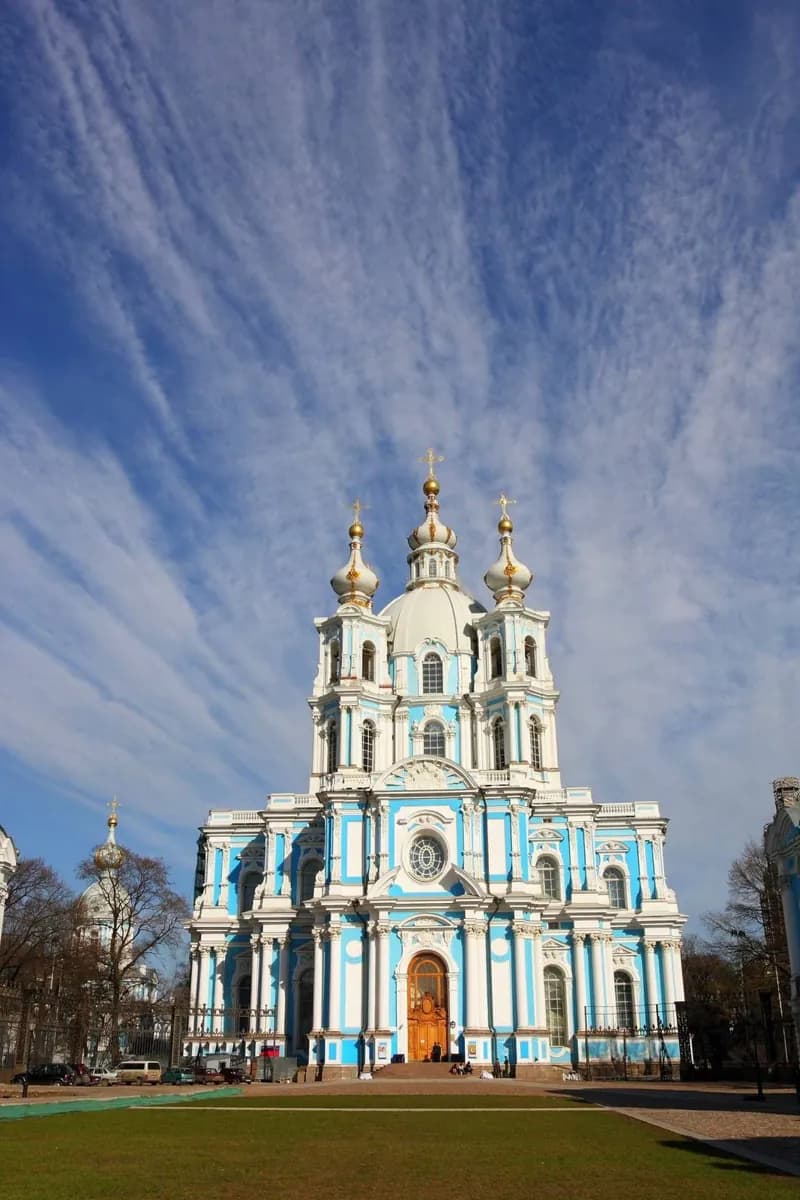
Smolny Convent or Smolny Convent of the Resurrection, located on Ploschad Rastrelli, on the bank of the River Neva in Saint Petersburg, Russia, consists of a cathedral (sobor) and a complex of buildings surrounding it, originally intended for a convent. The convent's main church (catholicon or sobor), a blue-and-white building, is considered to be one of the architectural masterpieces of the Italian architect Francesco Bartolomeo Rastrelli. The Cathedral is the centerpiece of the convent, built by Rastrelli between 1748 and 1764. The projected bell-tower was to become the tallest building in Saint Petersburg and, at the time, all of Russia. Elizabeth's death in 1762 prevented Rastrelli from completing this grand design. The building was only finished in 1835 by Vasily Stasov with the addition of a neo-classical interior to suit the changed architectural tastes at the time. The Cathedral was consecrated on 22 July 1835; its main altar was dedicated to the Resurrection and the two side altars were dedicated to St.
Useful to know
- Check the current admission calendar for Smolny Convent before building an interior visit around it.
Your next visit
Estimated · Declared scenario and planning estimates; no live opening, weather, queue or booking service.
Outdoor visit · 30–45 min
World planning estimate; admission, opening, visit duration and access need checking.