
Why go
Plan by station name and line rather than by road distance. Allow time for transfers inside major hubs, check whether a train is local or express, and use the same fare medium consistently where accepted by the relevant operator. Use Tokyo Trains and Metro as the planning lens; details in Tokyo Trains and Metro connect each choice with concrete places and timing.
The full story
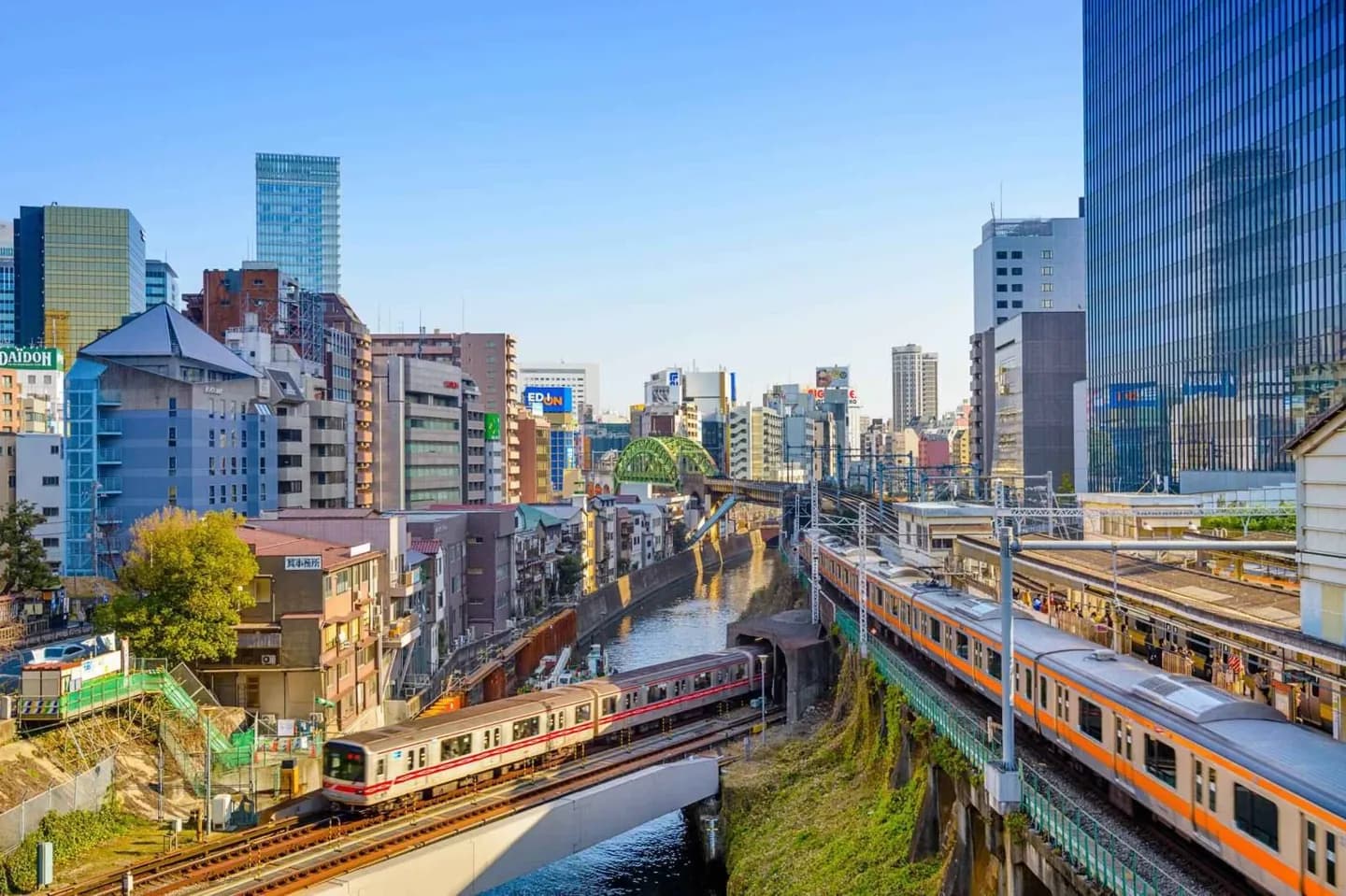
By train & metro Tokyo has one of the most extensive mass transit systems in the world and is the most used subway system in the world in terms of annual passenger rides. It is clean, safe and efficient – and confusing. The confusion arises from the fact that several distinct railway systems operate within Tokyo – the JR East network, the two subway networks, and various private lines – and different route maps show different systems. Avoid rush hours if possible; trains get overcrowded very easily. The defining rail line in Tokyo is the JR Yamanote Line , which runs in a loop around central Tokyo; being inside the Yamanote loop is synonymous with being in the core of Tokyo. Almost all inter-regional JR lines and private lines start at a station on the Yamanote. JR's lines are color-coded, and the Yamanote is light green. The JR Chuo Line (orange, 中央線 Chūō-sen) and Chuo-Sobu Line (yellow, 中央・総武線 Chūō-Sōbu-sen) run side-by-side, bisecting the Yamanote loop from Shinjuku on the west to Tokyo on the east. JR's other commuter lines, the Saikyo and Keihin-Tohoku, run off the rim of the Yamanote loop to the north and south. JR East has a good English information line, 050-2016-1603 or 03-3423-0111. Subway lines Tokyo has an extensive subway network with frequent trains, and these are primarily useful for getting around within the Yamanote loop.
Useful to know
- Confirm current details from the relevant official operator before relying on this tokyo trains and metro advice.