
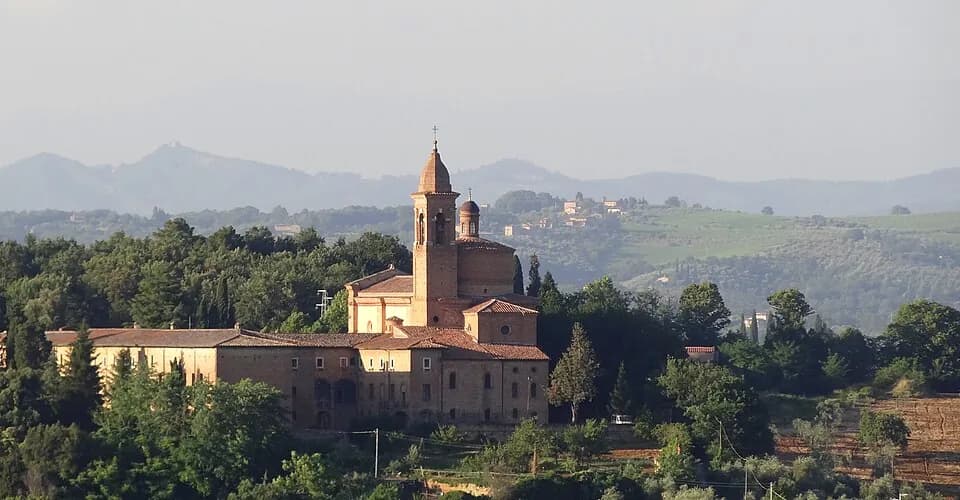
Why go
Come for a quieter encounter with works linked to Sano di Pietro, Andrea della Robbia and Bartolomeo Neroni. The basilica’s restored form also carries an unusual layer of twentieth-century history alongside its Renaissance origins, making the building itself as meaningful as the art it contains.
What to look for
- Renaissance forms define the church’s rebuilt exterior.
- Works associated with Sano di Pietro and Andrea della Robbia are held here.
The full story
The observant Franciscan complex grew on Siena’s outskirts in the late fifteenth century, with Francesco di Giorgio often linked to its design. Pandolfo Petrucci supported an expansion soon afterward. The church has passed through several episodes of damage and repair, so its appearance is also a record of what Siena chose to preserve. It suffered during the sixteenth-century siege of the city and was rebuilt in later centuries. In January 1944, bombing almost destroyed the basilica. Its postwar reconstruction drew on photographs and the knowledge retained by the resident friars. Keep that history in mind when looking at the apparently unified Renaissance forms: much of what you see was carefully recovered after a break, not simply left untouched for five centuries. Inside, artworks associated with Sienese painters and sculptors give the visit another connection to the city’s artistic tradition, even though the church stands away from the densest cluster of central sights.
Useful to know
- Treat the outlying basilica as a dedicated stop, rather than a quick detour from Piazza del Campo.
- Confirm sightseeing access with the church before setting out; published Mass times do not establish visitor hours.
Your next visit
Estimated · Declared scenario and planning estimates; no live opening, weather, queue or booking service.
Outdoor visit · 30–45 min
World planning estimate; admission, opening, visit duration and access need checking.