
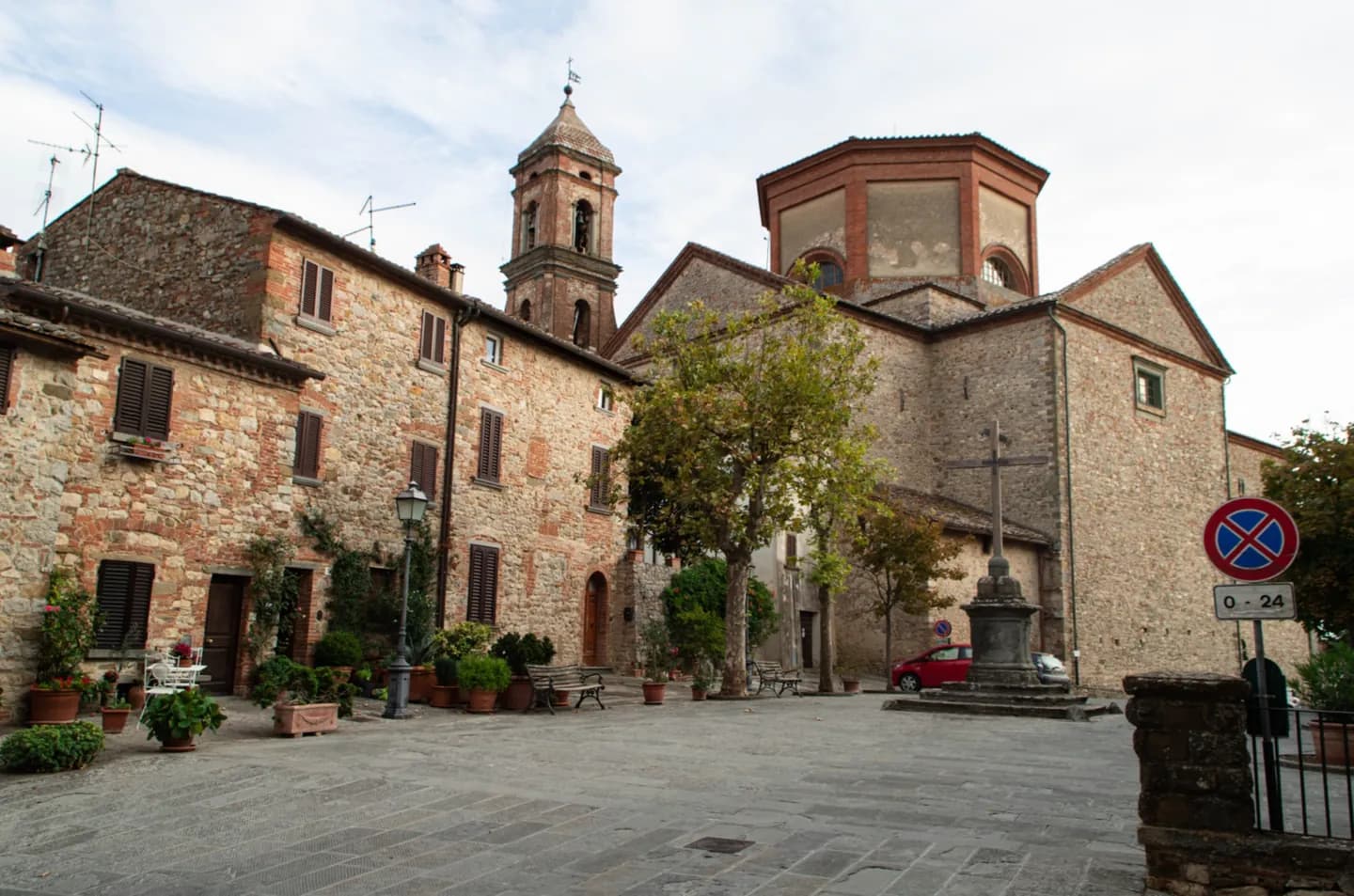
Why go
Walk a circuit of the concentric lanes to see how the medieval town fits its hill. The walls and compact pattern reflect a position once contested by Siena, Arezzo, Florence and Perugia; the civic museum adds the elaborate Tree of Life reliquary if open.
What to look for
- Concentric streets curve around the hill rather than crossing a regular grid.
- The medieval walls enclose the elliptical historic centre.
- The civic museum preserves the gilded Tree of Life reliquary.
The full story
Lucignano’s oval plan is a record of its defensive past. The lanes wrap the hill in concentric rings inside the walls, a layout that becomes clear only when you walk more than one circuit. Between the thirteenth and sixteenth centuries this position in the Valdichiana drew competing claims from Siena, Arezzo, Florence and Perugia. The built town still gives a sense of why holding the hill mattered. A different kind of history survives in the civic museum’s Tree of Life. This large gilded and jeweled reliquary was made for a Franciscan church and bears the names of two goldsmiths working more than a century apart, in 1350 and 1471. If the museum is open, it is a striking counterpart to the austere streets outside: an object of patient workmanship within a town shaped by territorial rivalry.
Useful to know
- Trace an outer lane and then cut inward to appreciate the town plan.
- Check civic museum access if you want to see the Tree of Life.
Your next visit
Estimated · Declared scenario and planning estimates; no live opening, weather, queue or booking service.
Outdoor visit · 30–45 min
World planning estimate; admission, opening, visit duration and access need checking.