
Why go
Follow the main street from Porta al Prato to Piazza Grande to see medieval street form give way to Renaissance palaces. The town also anchors Vino Nobile di Montepulciano, a local wine whose name refers to the place. Its architecture and ridge-top setting make the climb worthwhile even without a tasting.
What to look for
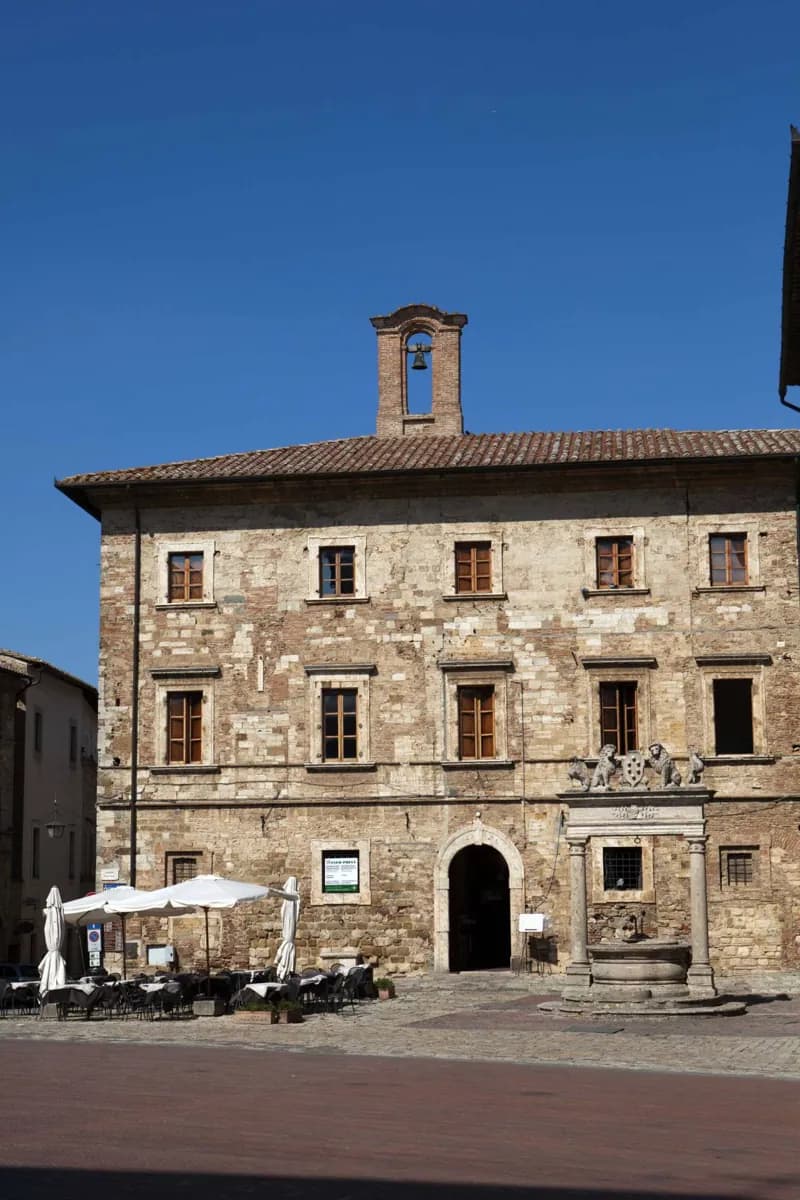
- Piazza Grande gathers the Palazzo Comunale, cathedral and Renaissance palace fronts.
- The main street rises from Porta al Prato to the town's upper square.
- San Biagio stands outside the walls, below the hill town.
The full story
Montepulciano occupies a high ridge between two Tuscan valleys, a setting that helped shape its defensive position and its long main street. The route from Porta al Prato to Piazza Grande rises through the medieval fabric before opening onto buildings from a period of close ties with Florence. The Palazzo Comunale echoes Florentine civic architecture, while palaces around the square show the wealth that reached the town in the fifteenth and sixteenth centuries. The cathedral holds a large Assumption triptych by the Sienese painter Taddeo di Bartolo, a reminder that artistic connections crossed political boundaries. Below the walls, Antonio da Sangallo the Elder's church of San Biagio belongs to a different experience of the place: its clear Renaissance geometry stands apart from the dense hilltop streets. Montepulciano's wine identity is tied to the surrounding vineyards, but the urban climb itself explains much of the town's character.
Useful to know
- Expect a sustained uphill walk to Piazza Grande; leave time for the return downhill.
- Treat San Biagio as a separate descent from the center rather than a quick detour from the square.
Your next visit
Estimated · Declared scenario and planning estimates; no live opening, weather, queue or booking service.
Outdoor visit · 15–25 min
World planning estimate; admission, opening, visit duration and access need checking.