
Why go
Enter through an old gate and the town’s defensible position becomes obvious. The Orsini Fortress and Masso Leopoldino frame two sides of the settlement, while nearby rock-cut routes connect its medieval fabric to an older Etruscan landscape. Each gate opens onto a different part of the cliffside town.
What to look for
- Porta di Sopra leads into the centre below the Orsini Fortress.
- Masso Leopoldino forms a fortified panoramic terrace.
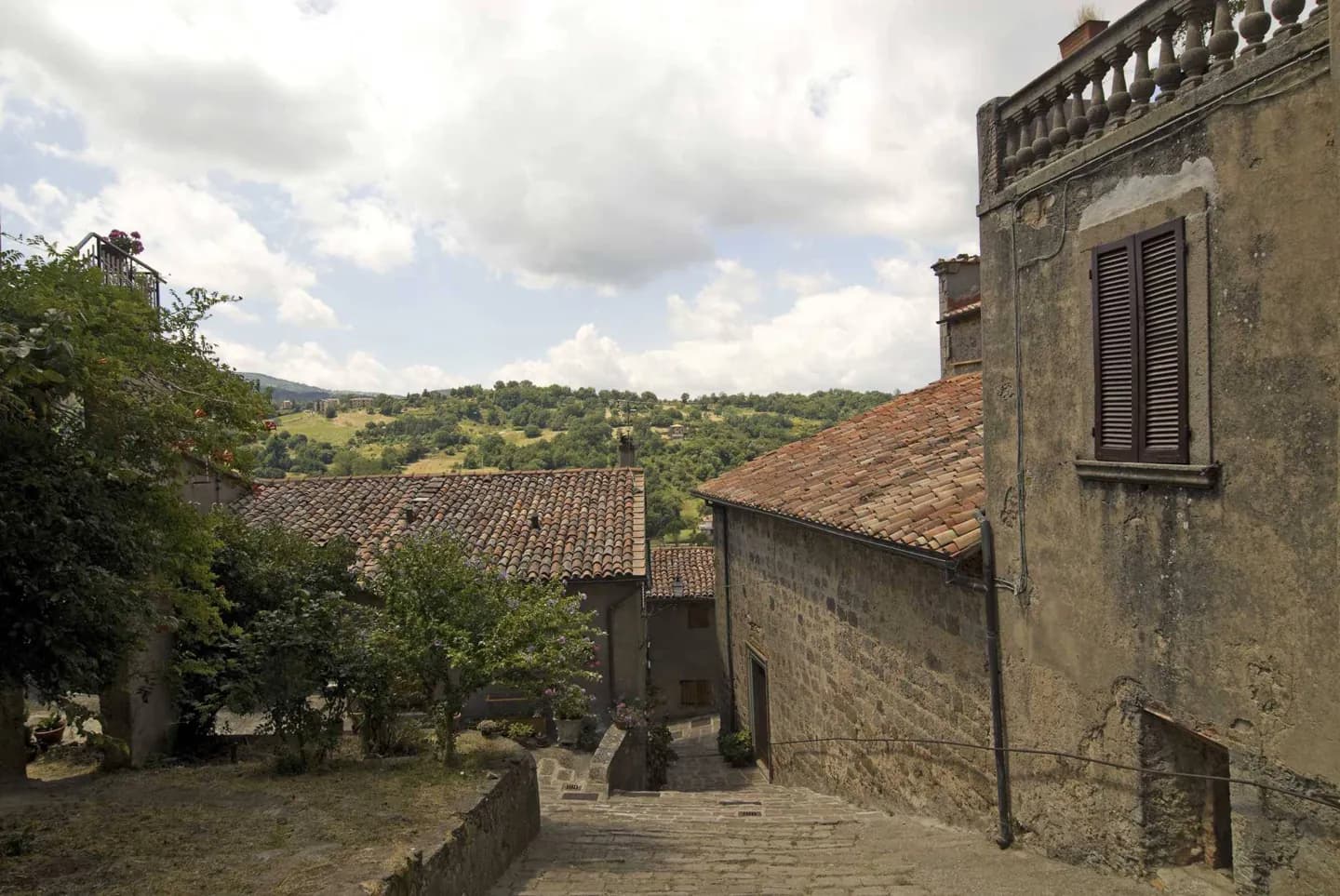
- Narrow alleys run among buildings set against the tuff cliff.
The full story
Sorano’s cliff above the Lente River gave it a natural defense. The settlement had Etruscan roots, but its most visible structures speak to later rivalry in southern Tuscany. The Aldobrandeschi ruled the area for centuries; the Orsini inherited it and refashioned the fortress, giving the town a strong military profile. Entering by Porta di Sopra places that fortress above you, while Porta dei Merli lies near Masso Leopoldino on the other side. The latter is a natural tuff mass shaped into a fortified terrace under Grand Duke Leopold. Between these points, alleys wind through buildings that seem pressed into the rock. Beyond the town, vie cave cut through tuff recall an older way of moving through this landscape. Sorano therefore works at two scales: a close walk through its gates and lanes, and a wider look at the carved terrain shared with Pitigliano and Sovana.
Useful to know
- Expect steep lanes and steps between the gates and viewpoints.
- Check fortress and museum access separately.
- Plan a vie cave walk separately and confirm its route conditions first.
Your next visit
Estimated · Declared scenario and planning estimates; no live opening, weather, queue or booking service.
Outdoor visit · 30–45 min
World planning estimate; admission, opening, visit duration and access need checking.