
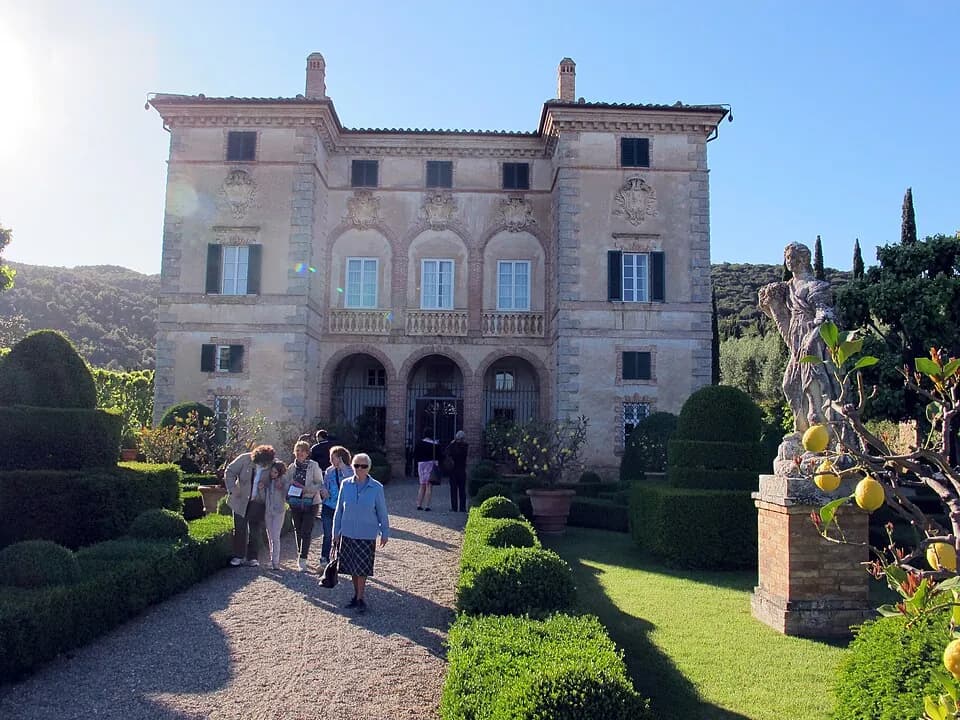
Why go
The strongest reason to come is the long garden axis, which connects the villa to the Romitorio on the hill above. Formal planting gives way to woodland, chapels and sculpture, making the grounds richer than a single terrace view. Confirm an available garden appointment before planning the journey.
What to look for
- Geometric beds and a citrus garden frame the villa.
- A cypress-lined axis leads toward the hillside Romitorio.
- The Tebaide woodland contains chapels and sculpture.
The full story
Villa Cetinale began as a Chigi family property west of Siena. Fabio Chigi commissioned a new house in the mid-seventeenth century; after he became Pope Alexander VII, work paused. His nephew Cardinal Flavio Chigi later brought in Carlo Fontana to reshape the villa and gardens. The result is best understood as a line through the landscape. Near the house are formal beds and a citrus garden; beyond them, cypresses draw the eye toward a long stair and the Romitorio high on the wooded slope. A secondary route reaches the Tebaide, where chapels and sculpture turn a walk into a sequence of religious images. This mix of geometry, distance and woodland is the garden's central idea. Later owners altered and restored the estate, including major twentieth-century work after Antony Lambton acquired it. A garden visit can reveal that layered history, but the house is a private property and garden access depends on an arranged appointment.
Useful to know
- Arrange a garden visit in advance and reconfirm access with the operator before traveling.
- Expect the design to extend beyond the formal garden into a wooded hillside.
Your next visit
Estimated · Declared scenario and planning estimates; no live opening, weather, queue or booking service.
Outdoor visit · 30–45 min
World planning estimate; admission, opening, visit duration and access need checking.