
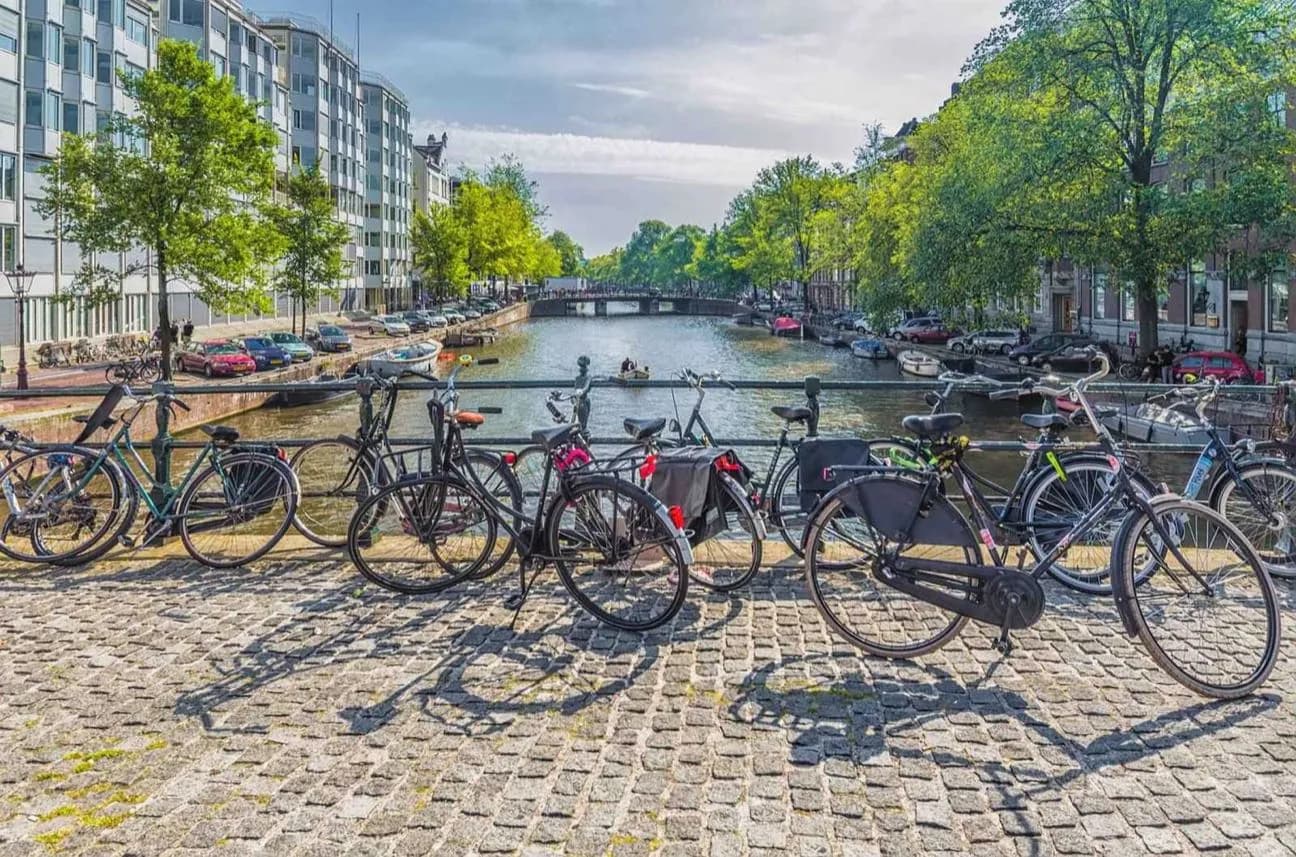
Why go
A bicycle opens routes along the Amstel, through Amsterdamse Bos and across the IJ toward Waterland. Inside the centre, its value comes with responsibility: red cycle lanes are traffic space, not leisurely extensions of the pavement, and local traffic moves with practiced speed.
The full story
Amsterdam's compact scale, flat ground and extensive cycle network make bicycles practical transport rather than recreation alone. Red lanes usually separate riders from cars and pedestrians, but the historic centre has narrow streets where users mix. Watch for bicycle-specific signals, yield markings and turning riders. Tram rails create a distinct hazard because a wheel can drop into the groove; cross them at a clear angle rather than riding along the track. Pedestrians should also understand that a cycle lane is an active carriageway. For a visitor, the best first ride may be away from the tightest central lanes. Routes along the Amstel, through Amsterdamse Bos or onto a ferry toward Noord give more room to learn the bike. Theft is another practical reality, so use the lock supplied by the rental company and secure the frame where parking is permitted. If the traffic feels too fast, walking and transit remain better choices.
Useful to know
- Cross tram rails at a clear angle and never ride along the groove.
- Keep out of pedestrian areas and follow bicycle-specific lights and markings.
- Lock the frame at an allowed rack whenever you leave the bike.