
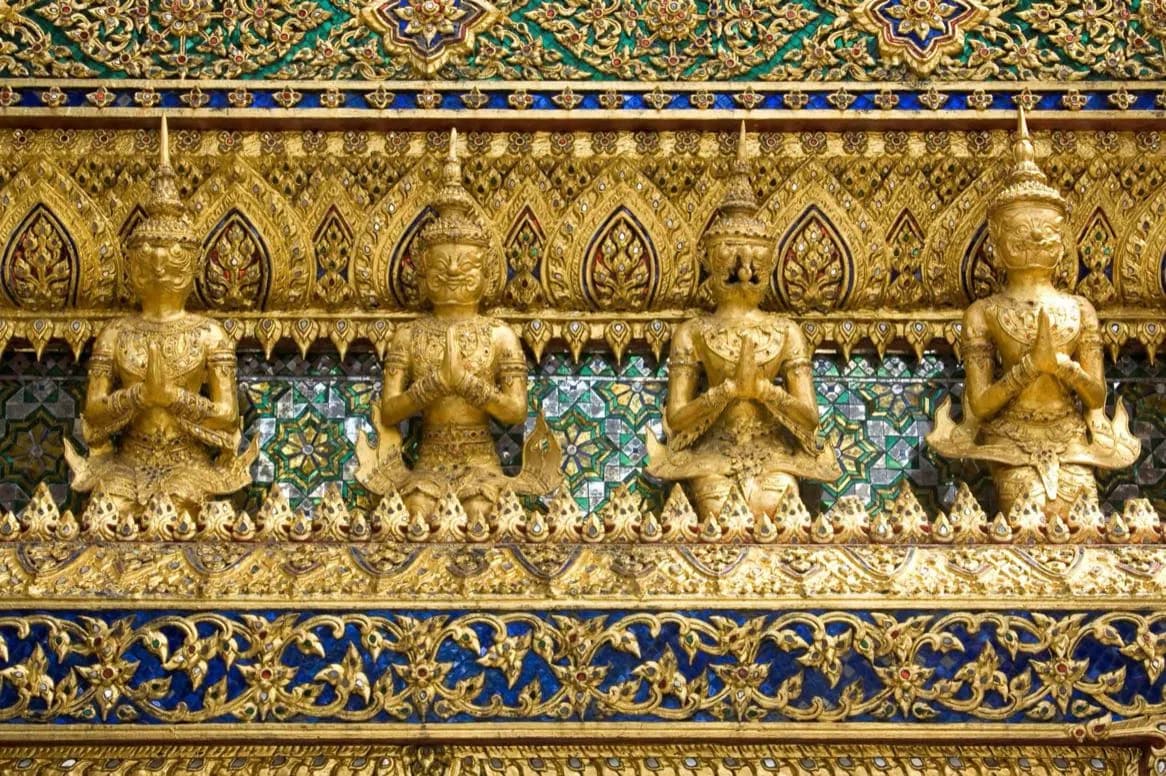
Why go
The palace turns the founding of modern Bangkok into architecture. Begin with the Temple of the Emerald Buddha, then read the Outer and Middle Courts as layers added by successive reigns. The changing styles, asymmetrical plan and continued use for royal ceremonies make the complex feel like an evolving seat of power, not a frozen monument.
What to look for
- Enter the Temple of the Emerald Buddha within the Grand Palace walls.
- Compare Chakri Maha Prasat with the contrasting halls of the Middle Court.
- Trace courtyards and pavilions accumulated over more than two centuries.
The full story
Construction began in 1782, when Rama I established Bangkok as the capital of the new Rattanakosin Kingdom. The palace became the residence of the king, court and royal government, and later rulers repeatedly enlarged or rebuilt it. That gradual development explains why its halls, pavilions, lawns and enclosed courts do not follow one symmetrical master plan. The compound is divided into distinct zones: the Temple of the Emerald Buddha, an Outer Court associated with public administration, a Middle Court of major throne and residential halls, and more restricted inner areas. By 1925, the royal family and government were no longer permanently based here, but the palace did not become an ordinary museum. Royal offices remain within the walls, and ceremonies and state functions continue to shape access. Notice the complex as both a historic capital project and a living institution.
Useful to know
- Follow the quarters in sequence instead of trying to understand the whole complex from one courtyard.
- Pair the palace with nearby Wat Pho, but leave enough attention for each large compound.
- Check the official timetable before leaving; ceremonies can change which areas are accessible.