
Why go
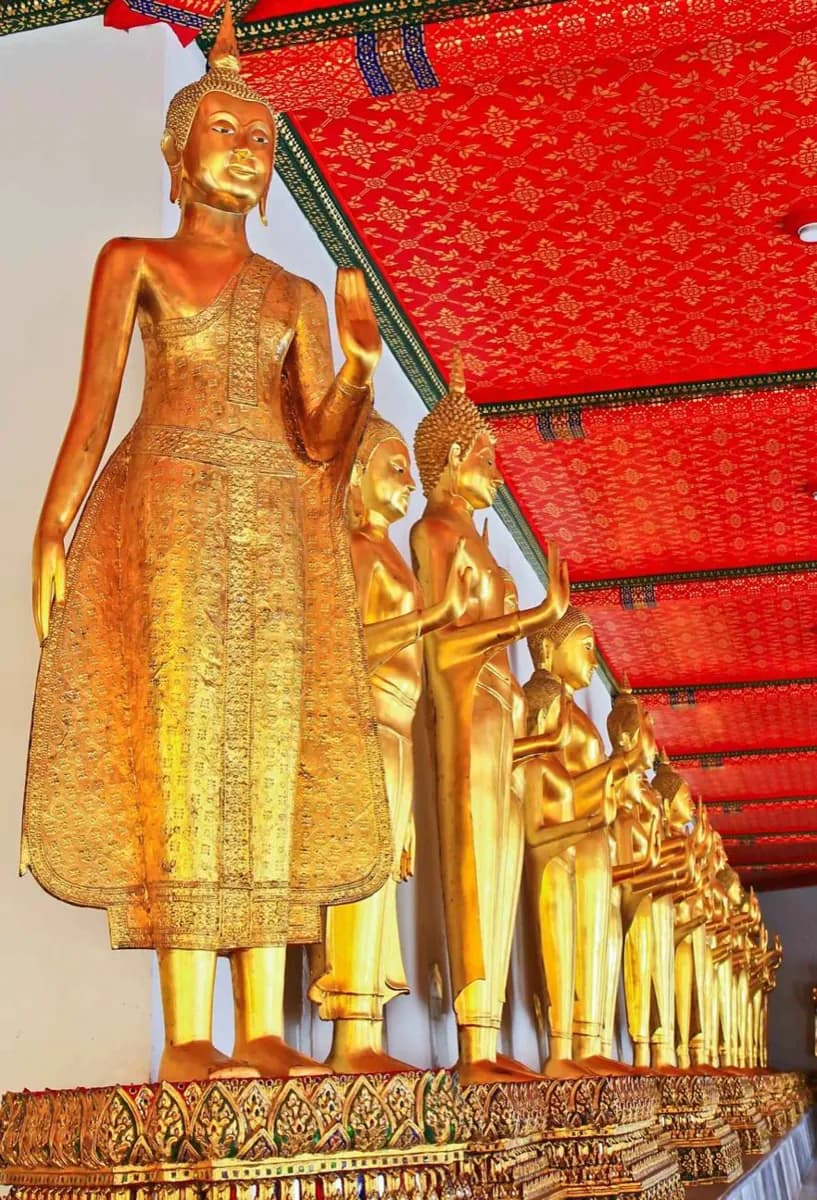
The 46-metre Reclining Buddha is only the opening image. Wat Pho also holds an unusually large collection of Buddha figures and marble inscriptions created for public instruction. Those details connect royal patronage, religious art, medicine and education in one compound, giving the visit more depth than a single famous statue.
What to look for
- Wat Pho’s 46-metre Reclining Buddha fills the scale of its enclosed hall.
- Marble illustrations and inscriptions reflect Wat Pho’s role in public education.
- Wat Pho’s courtyards contain numerous Buddha images and royal-period monuments.
The full story
Wat Pho stands on an older temple site and carries the formal name Wat Phra Chetuphon Wimon Mangkhalaram Rajwaramahawihan. Rama I rebuilt the complex after Bangkok became the capital and made it an important royal temple; later, Rama III expanded and extensively renovated it. The temple’s significance extends beyond the Reclining Buddha. Its many Buddha images form an unusually large collection, while inscriptions and illustrations placed around the grounds were intended to preserve and share knowledge. They cover subjects associated with religion, literature, medicine and the body, helping explain Wat Pho’s reputation as an early center of public education. The temple’s continuing school of Thai medicine and traditional massage grows from that same idea: knowledge is embedded in the place, not separated from worship and architecture. Look for the relationship between images, texts and teaching as you move through the compound.
Useful to know
- See the Reclining Buddha first, then slow down for the courtyards and instructional inscriptions.
- Combine Wat Pho with the Grand Palace immediately to the north rather than crossing the old city twice.
- Check the temple’s official visitor page before setting out because published access information can change.