
Why go
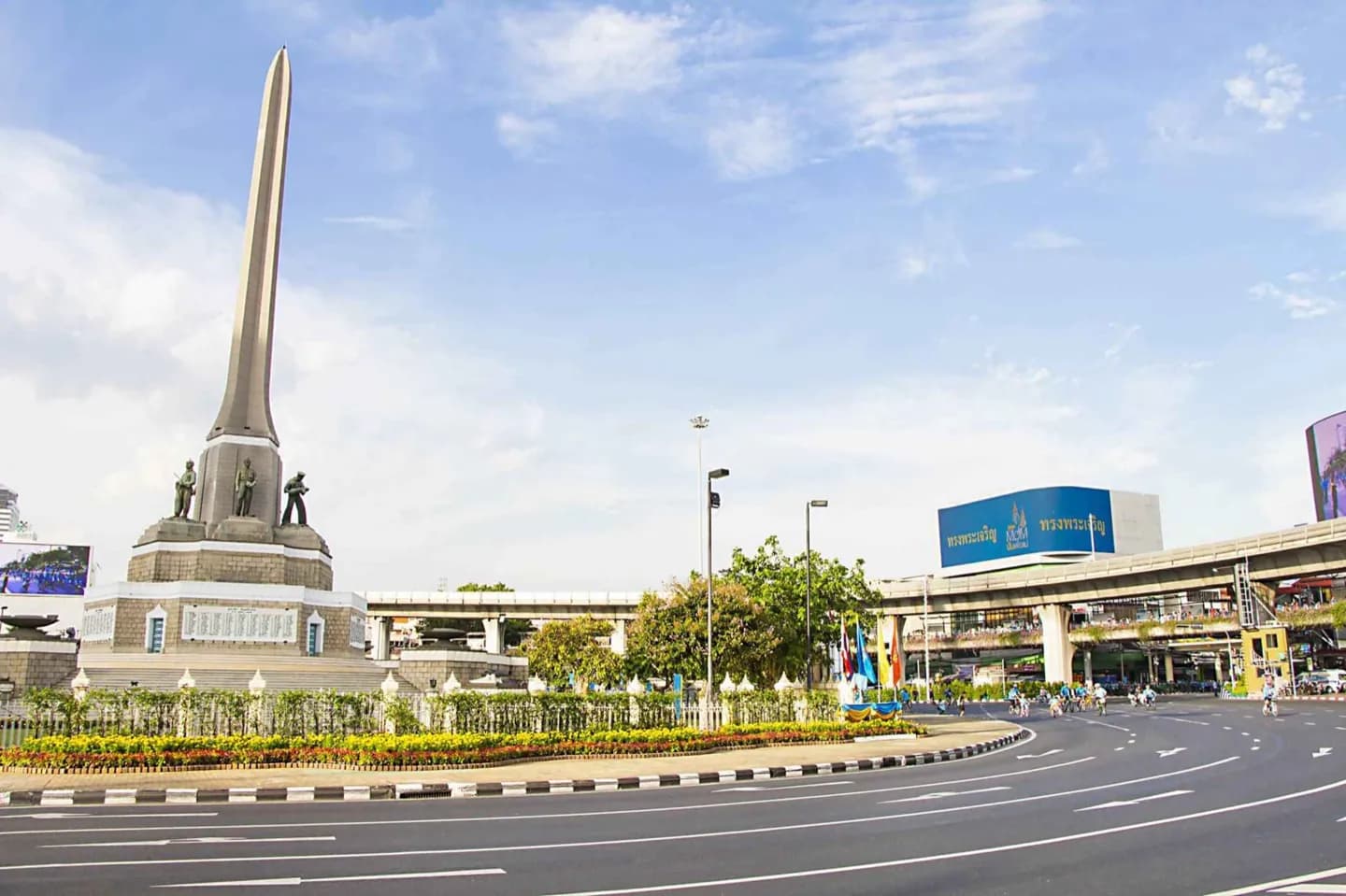
The monument rewards historical skepticism more than ceremonial admiration. Its western heroic style, military figures and sword-like central form celebrated Thailand’s 1941 gains in the Franco-Thai War. Those territories were returned after the Second World War, leaving the monument as both a transport landmark and an uncomfortable relic of nationalist politics.
What to look for
- Read five bayonet-like forms joined into Victory Monument’s central obelisk.
- Identify figures for the army, navy, air force, police and civilian service.
- Contrast its western heroic style with the Thai symbolism of Democracy Monument.
The full story
Victory Monument was erected rapidly in 1941 to celebrate Thailand’s territorial gains after the Franco-Thai War. The conflict with French colonial authorities in Indochina had been brief and inconclusive, and Japan imposed the final settlement on both sides. Thailand gained land in Cambodia and Laos, but after the Allied victory in 1945 it was required to return those territories. The monument’s triumphal message therefore became politically awkward almost as soon as it was established. Its design is entirely western in language. Five bayonet-like forms create the central obelisk, while statues represent the armed services, police and civilian bureaucracy in a heroic 1940s style. Italian-born sculptor Corrado Feroci, known in Thailand as Silpa Bhirasri, made the figures but disliked their combination with the obelisk. Today the traffic circle and transit interchange are as prominent as the memorial, embedding this contested history in everyday movement.
Useful to know
- Treat the monument as a city-scale exterior sight; it stands inside a heavily trafficked roundabout.
- Use the nearby transit area to understand its role as a transport landmark rather than attempting a close architectural visit.
- Pair it with Phaya Thai Road to read how the traffic and rail corridors organize this part of Bangkok.
Your next visit
Estimated · Declared scenario and planning estimates; no live opening, weather, queue or booking service.
Outdoor visit · 30–45 min
World planning estimate; admission, opening, visit duration and access need checking.