
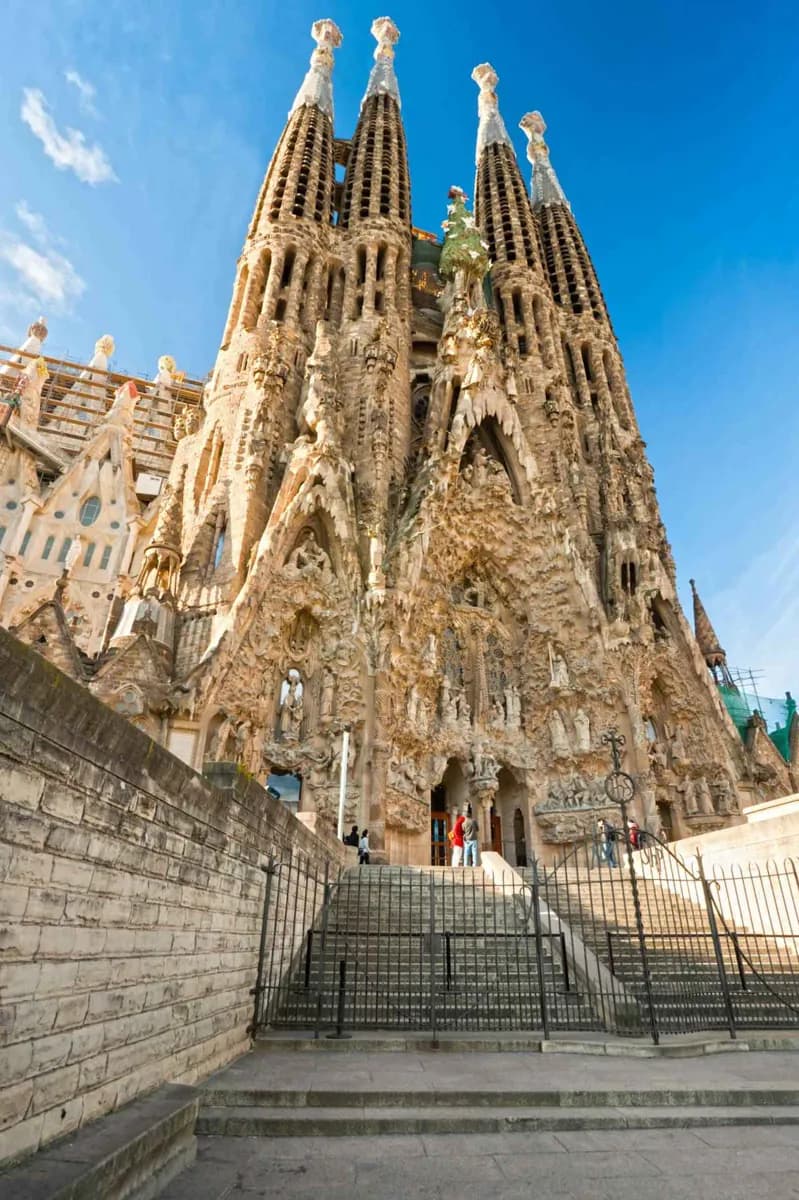
Why go
The Nativity and Passion façades tell the Christian story in different visual languages. Inside, branching columns and stained glass change the feel of the space. The visit is especially rewarding for anyone who wants to see how Gaudí joined structure, symbolism and light.
What to look for
- The Nativity façade layers figures and natural forms.
- The Passion façade uses a stark, angular treatment of its subject.
- Stained glass changes the colour of the nave’s light.
The full story
Work on Sagrada Família began in 1882 under Francisco de Paula del Villar; Antoni Gaudí took over the project the following year and transformed its design. He devoted his later life to the church, which continued after his death in 1926. The long construction history is part of what a visitor sees: different generations have interpreted and built from the original project. The Nativity façade carries dense natural forms and scenes, while the Passion façade is more severe in expression. Inside, columns branch upward and coloured windows bring changing light across the nave. The contrast between outside storytelling and interior structure gives the visit its shape. Gaudí’s work on the basilica forms part of a UNESCO World Heritage listing, but the building also functions as an active religious space. Approach it as both architecture and church, and leave time for a slow circuit rather than a quick photograph from one side.
Useful to know
- Book a dated entry through the basilica before building the rest of the day.
- Compare both façades before or after the interior visit.
- Check the official access information if stairs or tower access matter.
Your next visit
Estimated · Declared scenario and planning estimates; no live opening, weather, queue or booking service.
Outdoor visit · 60–105 min
World planning estimate; admission, opening, visit duration and access need checking.