
Why go
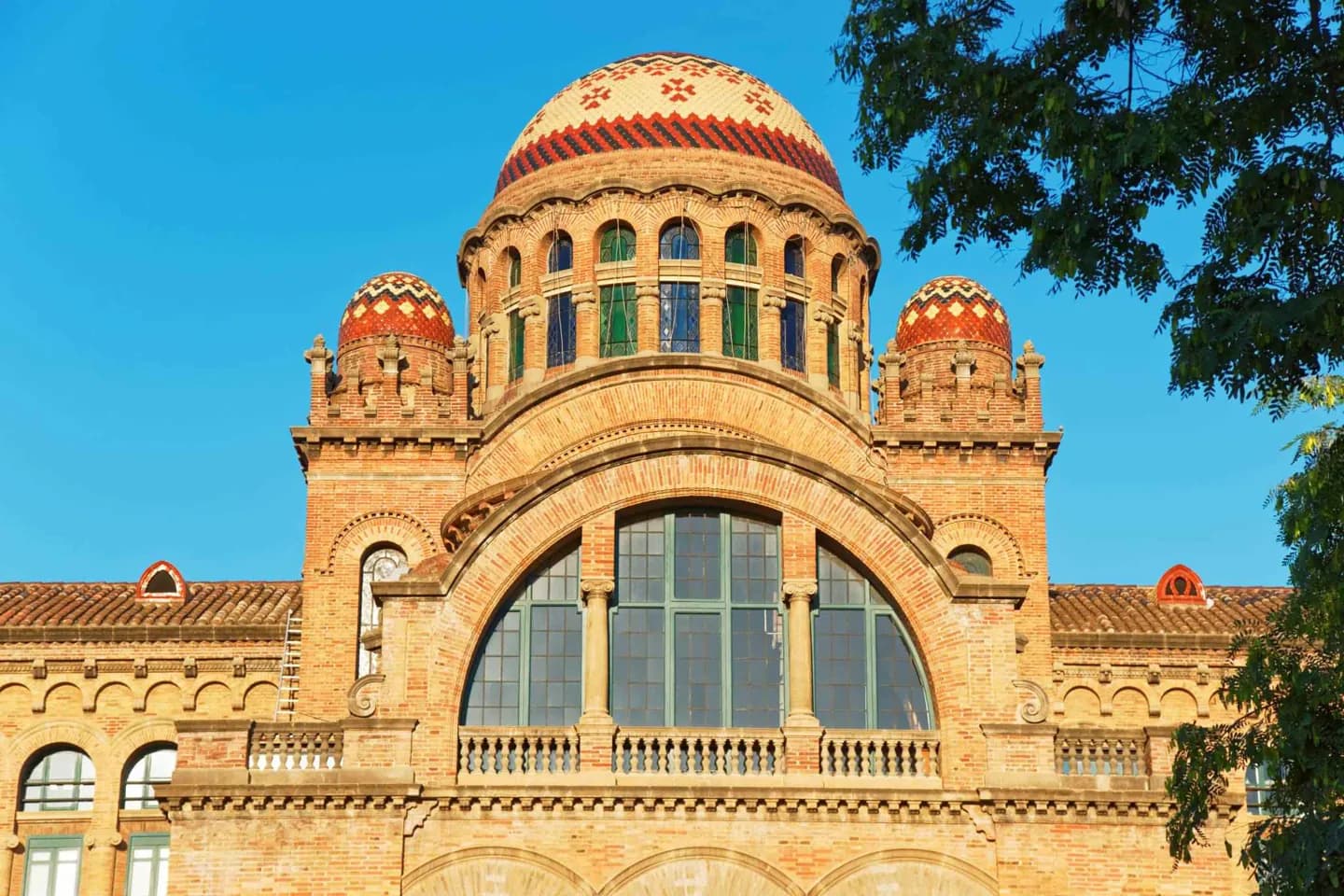
Domènech i Montaner planned healthcare buildings as a connected garden complex, rather than one imposing block. The pavilions, decorative surfaces and underground links reveal how architecture served patients and staff as well as civic pride. The garden setting gives its ornament an unusually open context.
What to look for
- Separate pavilions stand within gardens.
- Underground galleries connect parts of the former hospital.
- Modernista tile, brick and sculpture appear throughout the complex.
The full story
The Hospital de la Santa Creu has roots in a medieval hospital founded in 1401. Its later Sant Pau complex was built in the early twentieth century to designs by Lluís Domènech i Montaner. Separate pavilions sit around gardens and connect through underground galleries. This layout is essential to the visit: it shows an attempt to give hospital departments light, air and room while keeping services linked. Decorative brickwork, tile and sculpture sit alongside that practical plan. The historic complex served as a hospital until a new facility opened nearby, and the restored buildings later became a cultural visitor site. Along with Domènech i Montaner’s Palau de la Música Catalana, it forms a UNESCO World Heritage listing. Walk through the garden spaces and at least one pavilion before focusing on details. Sant Pau pairs logically with Sagrada Família, but both reward enough time that one should not be reduced to a passing photo stop.
Useful to know
- Check the current visitor route for any closed pavilion.
- Allow enough time to explore beyond the entrance courtyard.
- Pair with Sagrada Família only if both visits have room in the day.
Your next visit
Estimated · Declared scenario and planning estimates; no live opening, weather, queue or booking service.
Outdoor visit · 60–90 min
World planning estimate; admission, opening, visit duration and access need checking.