
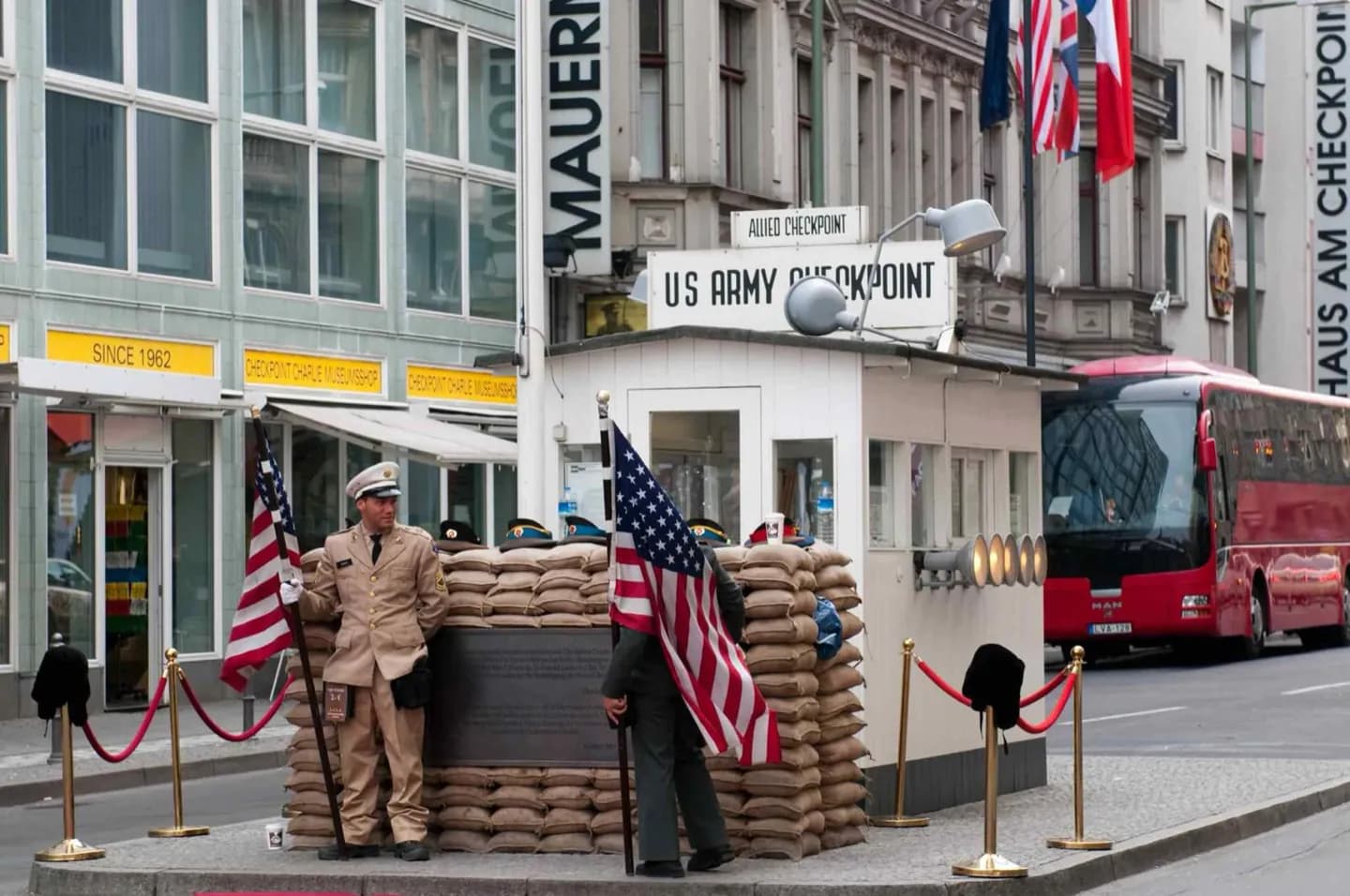
Why go
GDR leader Walter Ulbricht agitated and maneuvered to get the Soviet Union's permission to construct the Berlin Wall in 1961 to stop Eastern Bloc emigration westward through the Soviet border system, preventing escape across the city sector border from communist East Berlin into free West Berlin.
What to look for
- The street installation marks the best-known Allied crossing, where American and Soviet tanks confronted one.
The full story
After the dissolution of the Eastern Bloc and the reunification of Germany, the building at Checkpoint Charlie became a tourist attraction. It is now located in the Allied Museum in the Dahlem neighborhood of Berlin. Background Emigration restrictions, the Inner German border and Berlin By the early 1950s, the Soviet method of restricting emigration was emulated by most of the rest of the Eastern Bloc, including East Germany. However, in occupied Germany, until 1952, the lines between East Germany and the western occupied zones remained easily crossed in most places. Consequently, the inner German border between the two German states was closed and a barbed-wire fence erected. Even after closing of the inner German border officially in 1952, the city sector border in between East Berlin and West Berlin remained considerably more accessible than the rest of the border because it was administered by all four occupying powers.
Useful to know
- Visit in daylight for the clearest reading of the architecture and surrounding urban space.
- Combine the stop with nearby sights on foot, allowing extra time only for any separate interior component.