
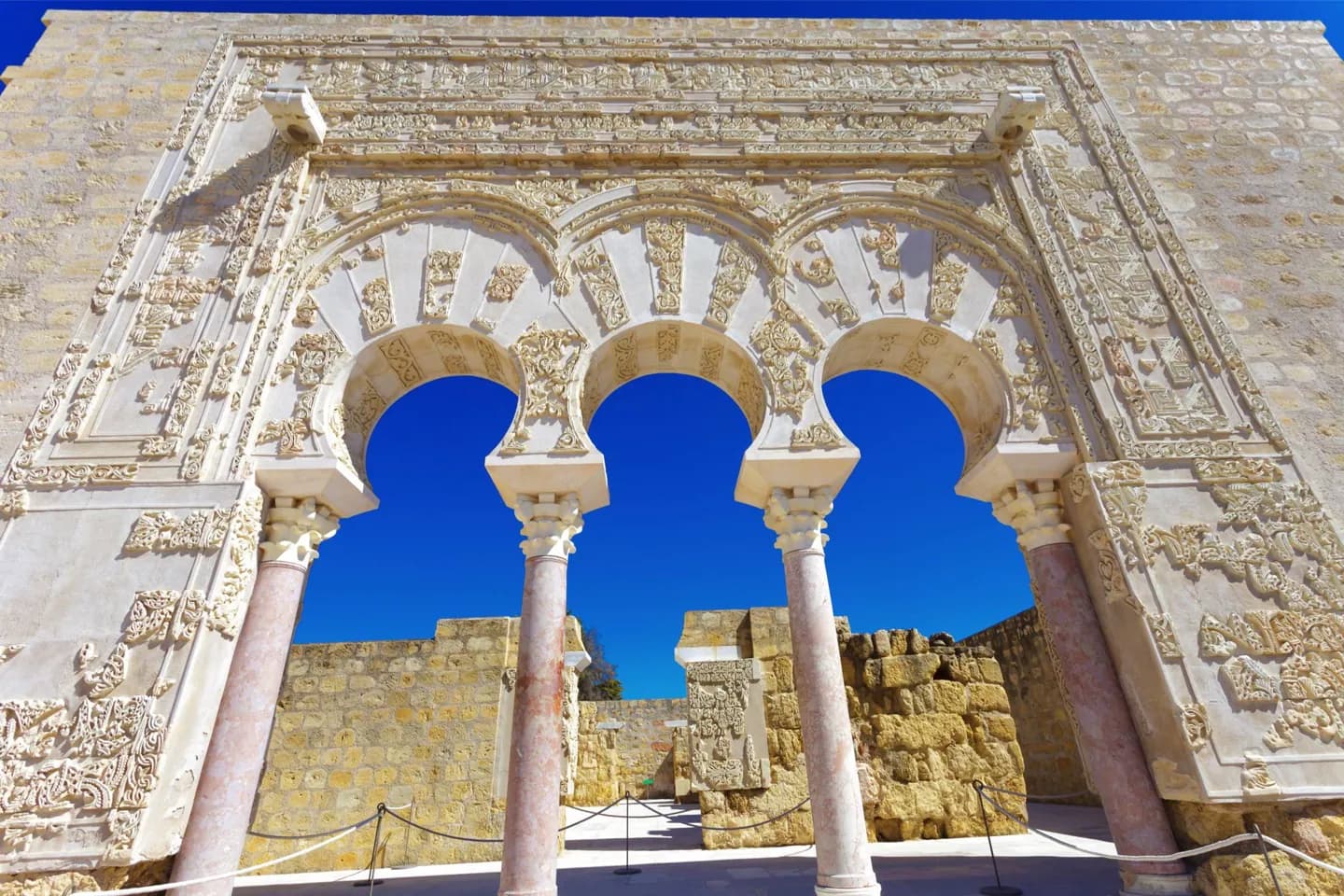
Why go
This was a seat of government, not merely a lavish retreat. The stepped plan placed the caliph’s palace above reception halls, gardens and service areas, making political rank visible in the landscape. Walking the remains helps you picture the scale and ambition of tenth-century Córdoba far beyond the old city centre.
What to look for
- The terraces descend from palace ground toward the Guadalquivir valley.
- Excavated rooms reveal ceremonial, residential and service functions.
- The museum introduces the wider city beyond the visible ruins.
The full story
Abd al-Rahman III began Madinat al-Zahra in the tenth century as the seat of his new caliphate. Its layout used the foothills of the Sierra Morena as a political stage: palace buildings occupied the upper levels, with administration, gardens and other parts of the city arranged below. Court visitors approaching the complex would have encountered a carefully ordered display of authority. The city included more than ceremonial rooms; people worked and lived among offices, workshops, barracks, houses and baths. After civil war in the early eleventh century, it was sacked and abandoned, and stone was reused elsewhere. Excavation has exposed only a portion of the 112-hectare city. As you cross the terraces, remember that the visible ruins are a small part of a planned capital whose full extent still lies mostly beneath the hillside.
Useful to know
- Plan this as a separate outing west of central Córdoba.
- See the museum before the ruins to make sense of the fragmentary plan.
Your next visit
Estimated · Declared scenario and planning estimates; no live opening, weather, queue or booking service.
Outdoor visit · 30–45 min
World planning estimate; admission, opening, visit duration and access need checking.