
Why go
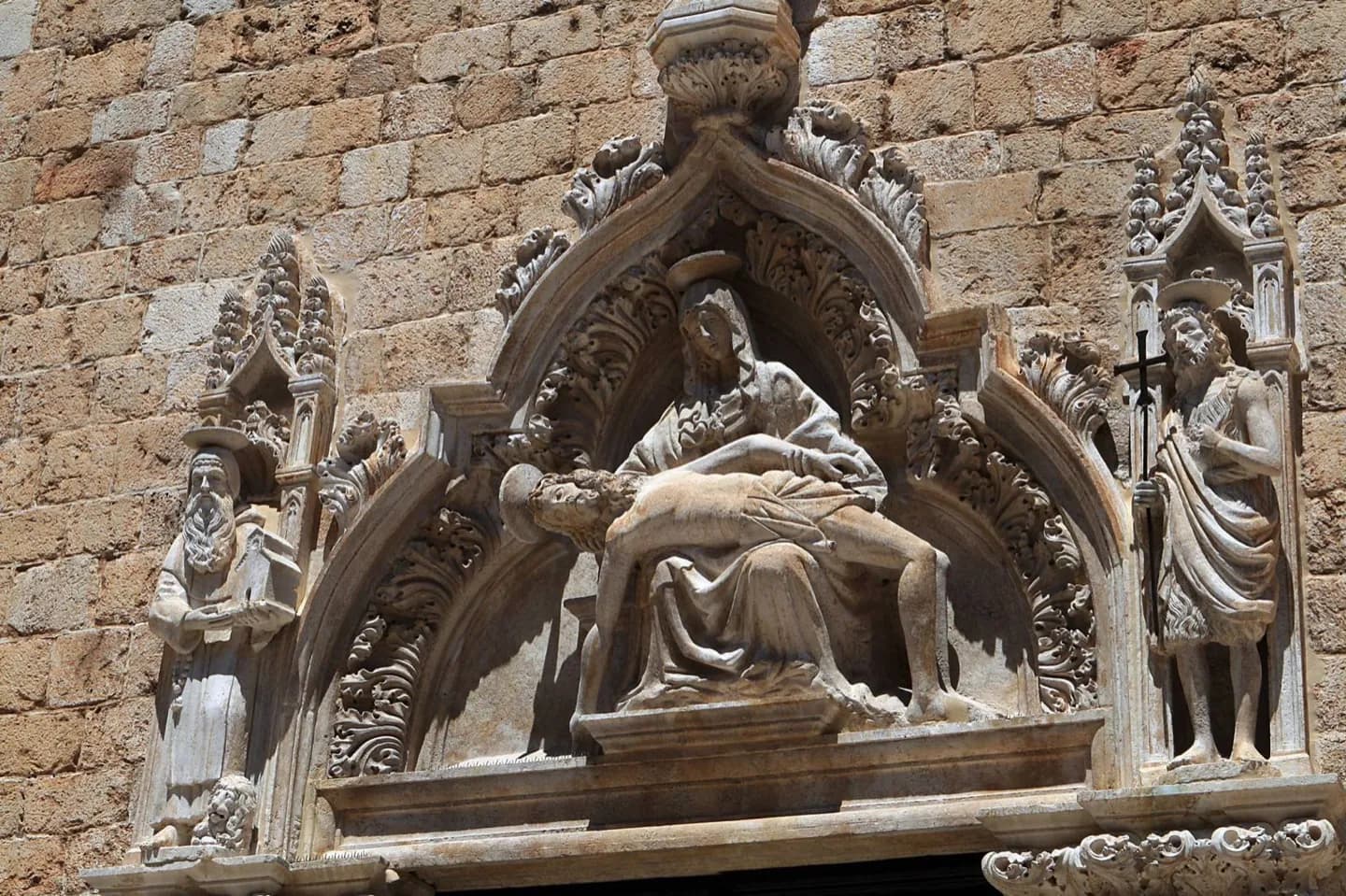
Look for the Pietà above the church entrance, then give the cloister its own time: the carved capitals vary from column to column. The pharmacy collection adds a practical history of medicine to the complex's religious and architectural story in Dubrovnik.
What to look for
- A Gothic south portal carries a carved Pietà by the Petrović brothers' workshop.
- The Romanesque-Gothic cloister has varied carved column capitals.
- The museum preserves material from the Friars Minor pharmacy.
The full story
The Franciscans moved inside Dubrovnik's walls in the early 14th century, beginning a complex that took generations to complete. The earthquake of 1667 destroyed the church, but its richly carved south portal survived; the Pietà above the entrance is therefore a piece of the earlier building still visible from Stradun. The church interior was rebuilt in Baroque style, creating a clear contrast with that Gothic stonework. In the monastery cloister, pairs of columns and differently carved capitals slow the eye down after the busy street outside. The complex also housed the Friars Minor pharmacy, whose early records reach back to 1317. Its surviving collection gives the monastery another role beyond worship: it served the everyday needs of Dubrovnik through medicine and record keeping. Treat the portal, cloister and collection as distinct parts of the visit.
Useful to know
- Start at the church portal from Stradun, then enter the cloister or museum if those areas are open.
- Check access to the church, cloister and museum separately before planning an interior visit.
Your next visit
Estimated · Declared scenario and planning estimates; no live opening, weather, queue or booking service.
Outdoor visit · 30–45 min
World planning estimate; admission, opening, visit duration and access need checking.