
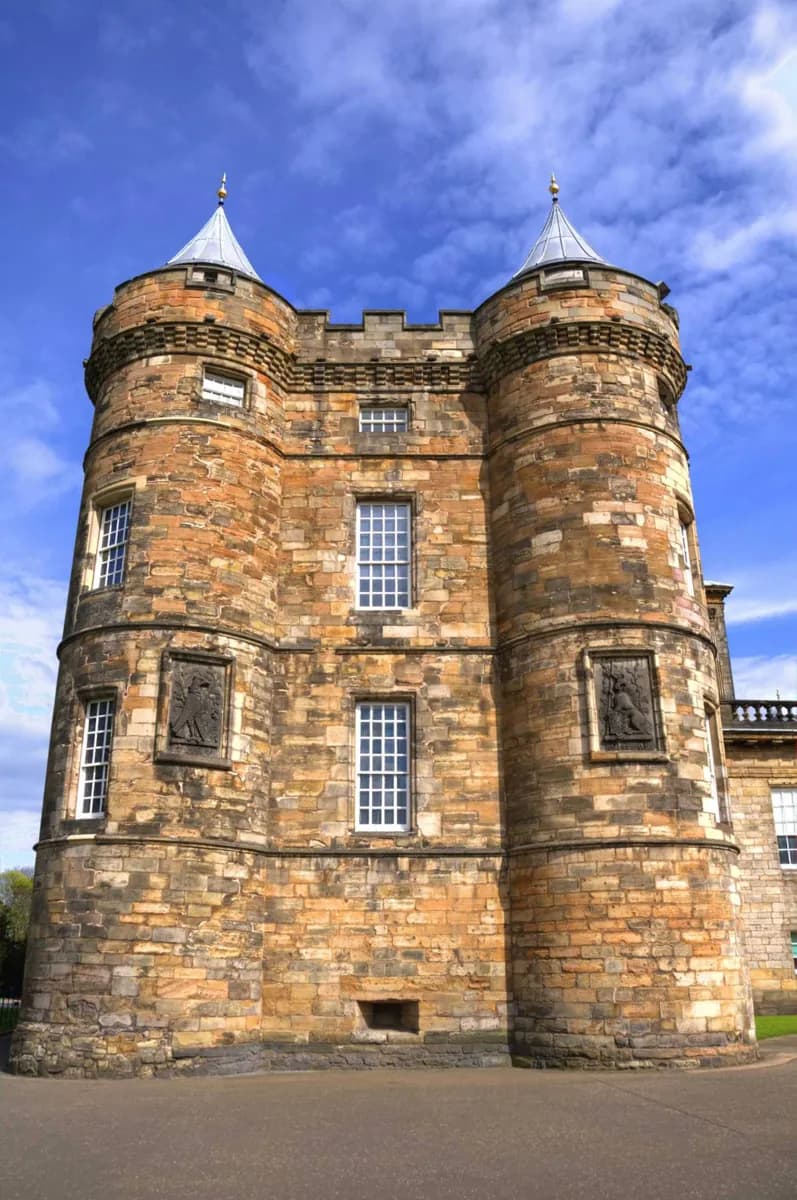
Why go
Holyroodhouse balances formal royal interiors with older rooms closely associated with Mary, Queen of Scots. Her ceilings and royal monograms give specific details to seek out, while the abbey places the residence in a longer medieval setting. The palace is a substantial indoor anchor at the opposite end of the Royal Mile from Edinburgh Castle.
What to look for
- Mary, Queen of Scots’ rooms retain wooden ceilings from her time.
- The monograms MR and IR refer to Mary and her son, James VI.
- The roofless Holyrood Abbey accompanies the palace visitor route.
The full story
David I founded Holyrood Abbey in 1128, and the site became a principal residence of Scotland’s kings and queens from the fifteenth century. The palace stands at the foot of the Royal Mile beside the older religious foundation, linking it historically with Edinburgh Castle while setting it apart from the dense ridge above. The palace grew around a quadrangle west of the abbey cloister, with royal lodgings, a chapel, a gallery and a great hall. Mary, Queen of Scots’ suite includes an audience chamber and a bedroom with access to turret rooms. Those domestic spaces belong to a palace that remains a working royal residence, so historical interiors sit within a continuing royal setting at the foot of the Royal Mile.
Useful to know
- Allow about an hour for the multimedia-guided State Apartments route, with additional time for the abbey.
- Check the palace’s official visitor arrangements before travelling, as royal use can change access.
Your next visit
Estimated · Declared scenario and planning estimates; no live opening, weather, queue or booking service.
Indoor visit · 60–90 min
World planning estimate; admission, opening, visit duration and access need checking.