
Why go
Understanding how the dictatorship operated makes its surviving sites and memorials more legible. Book burnings, concentration camps, racist laws, the Gestapo, and propaganda were parts of a coordinated system. The war and Holocaust cannot be separated from that system or reduced to a sequence of battles.
The full story
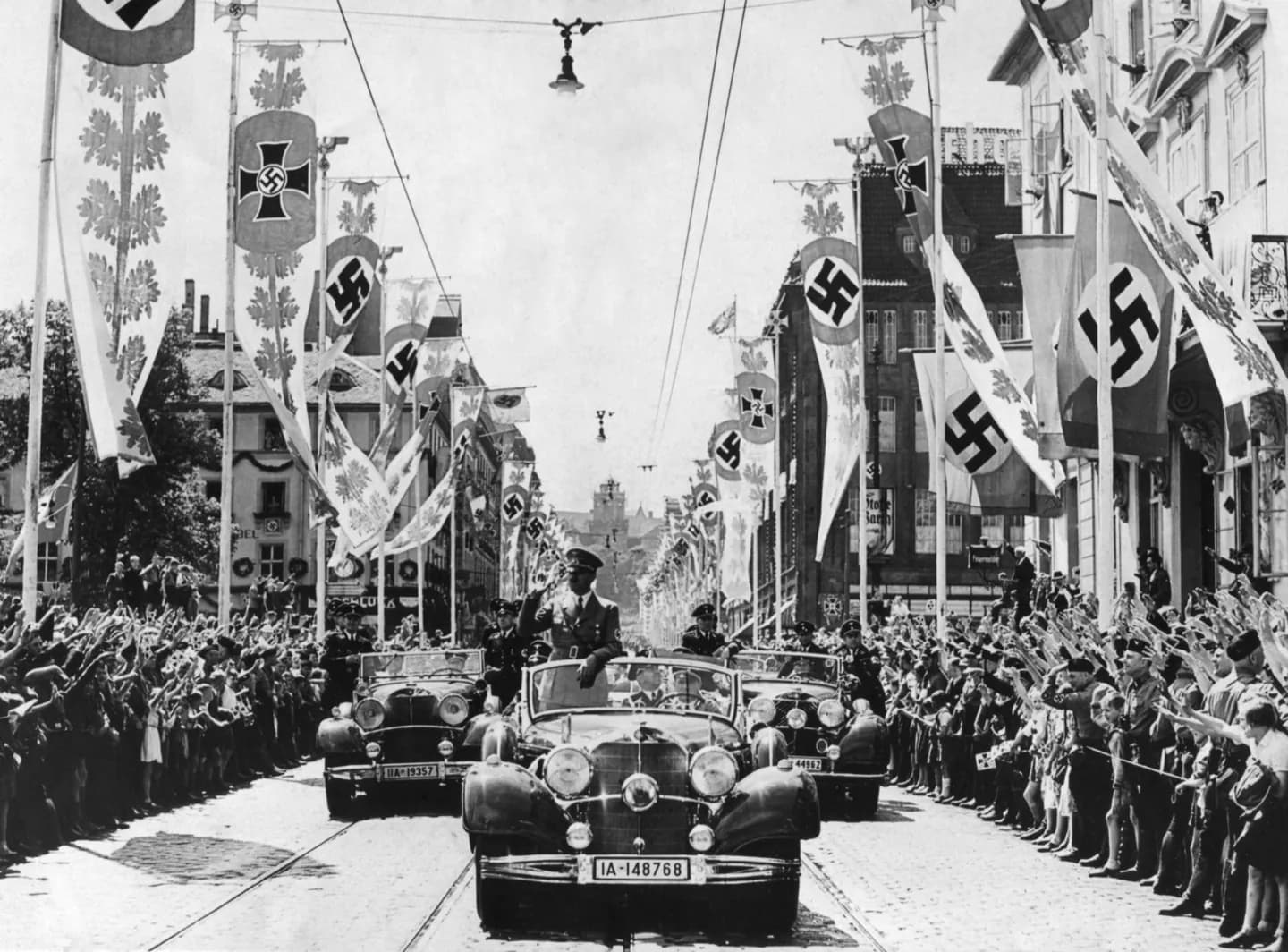
After taking power in 1933, the Nazis turned the German state into a one-party dictatorship under Adolf Hitler. They removed opponents from public institutions and opened concentration camps, initially to imprison political opponents including communists, social democrats, and trade unionists. Propaganda reached schools, culture, and daily life; unwanted books were publicly burned and art was censored. The Gestapo pursued political and ideological opponents. Hitler also ordered the murder of rivals within his own movement in 1934. The regime's anti-Jewish policy escalated from exclusion and theft to mass murder. The Nuremberg Laws of 1935 stripped Jews of rights and outlawed personal relationships defined by Nazi racial categories. Jewish businesses were expropriated, people were forced from work and homes, and the regime carried out the Holocaust. Nazi Germany invaded Poland on 1 September 1939, beginning the European war. Its armies occupied much of Europe before defeat on several fronts; Germany surrendered in May 1945. At museums and memorials, pay attention to the steps by which legal exclusion, terror, and war were made possible, and to the people targeted by them.