
Why go
Rossio works as both an orientation point and a compact lesson in Lisbon’s urban history. Its open ground has served the lower city since the Middle Ages, while the rebuilt façades and 19th-century paving show how successive eras remade the same civic stage.
What to look for
- Black-and-white paving runs across the square in a rolling wave pattern.
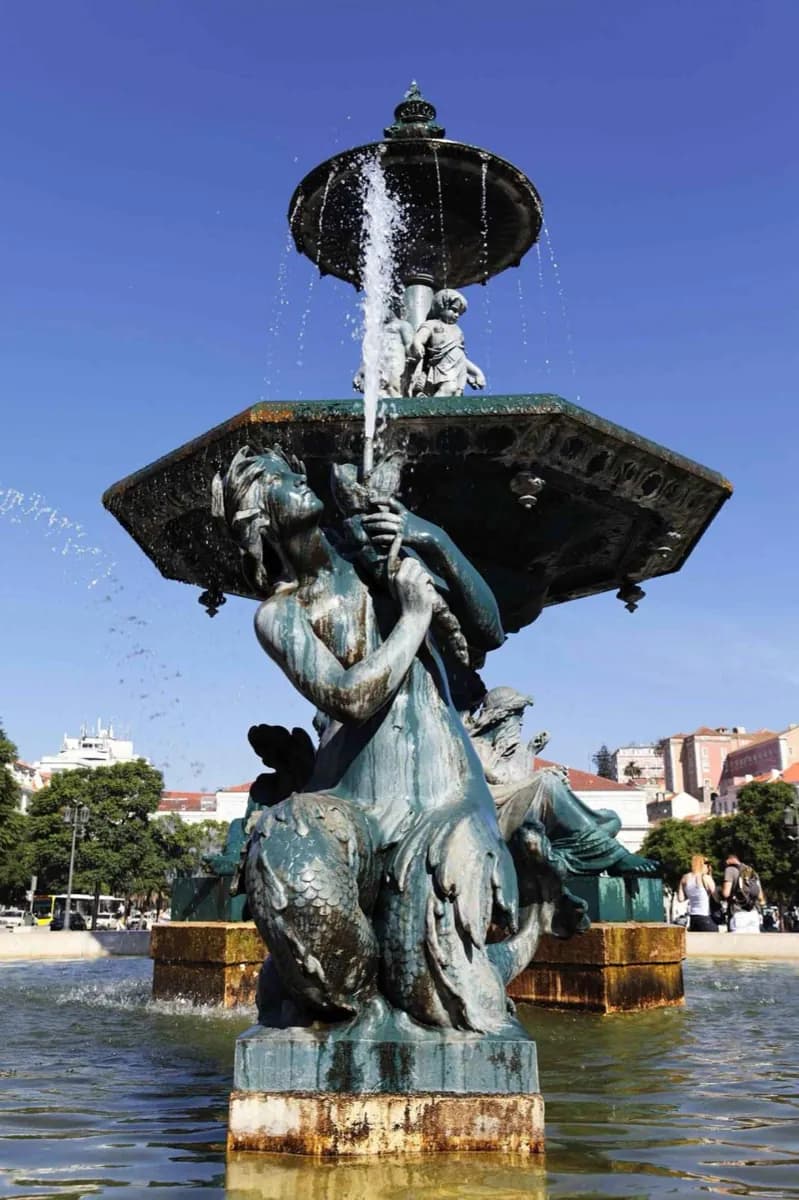
- The column of King Pedro IV anchors the centre between two bronze fountains.
- Pombaline façades enclose the square with a regular rhythm of windows and balconies.
The full story
Rossio became an important public space as medieval Lisbon expanded downhill from the castle. Its familiar name comes from a word for common ground, a clue to its long role as a gathering place rather than a ceremonial enclosure alone. The square witnessed celebrations, political unrest, bullfights and executions before the 1755 earthquake destroyed much of its built setting. Reconstruction gave the surrounding blocks the measured Pombaline character seen today. The 19th century added the black-and-white mosaic pavement, bronze fountains and the central column honoring Pedro IV. That monument also supplied the official name, Praça D. Pedro IV, though Rossio remained the everyday form. Reading the square from ground level therefore reveals several Lisbons at once: medieval common space, post-earthquake planning and a later civic taste for patterned stone and formal monuments.
Useful to know
- Cross the square rather than viewing it from one edge; the pavement pattern reads best while moving.
- Continue south through Baixa toward Praça do Comércio to compare Rossio’s enclosed form with the open riverfront square.
- Use Rossio as a pause between Baixa and the climb toward Lisbon Castle rather than as a long standalone stop.
Your next visit
Estimated · Declared scenario and planning estimates; no live opening, weather, queue or booking service.
Outdoor visit · 30–45 min
World planning estimate; admission, opening, visit duration and access need checking.