
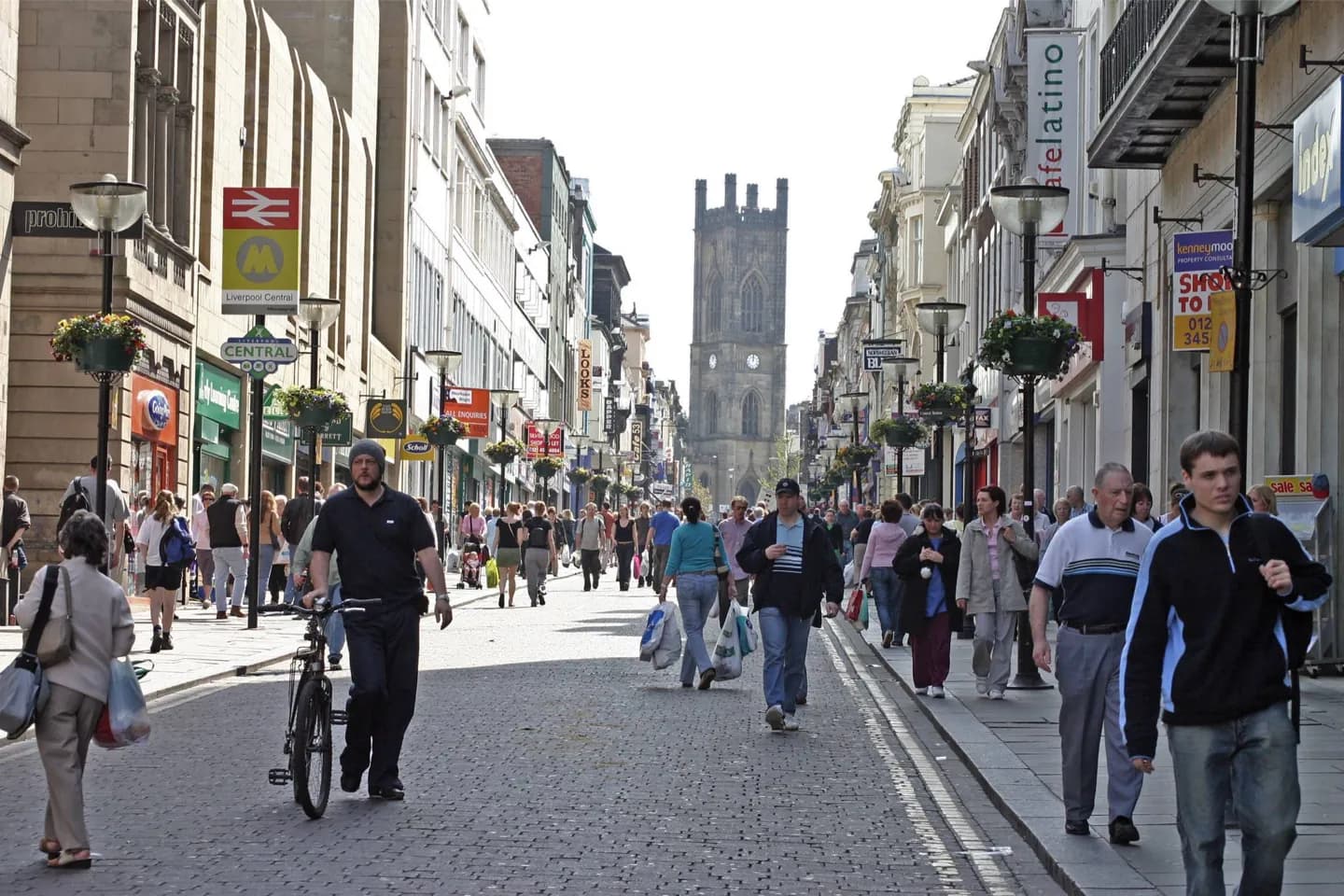
Why go
The street is rewarding as a transition: compare its busier lower end with the upper end by St Luke’s Church, then branch into the Ropewalks. It offers a readable piece of urban history even if a particular café or shop has changed.
The full story
Before Bold Street became a shopping street, this part of Liverpool was tied to the needs of sailing ships. Roperies required long strips of ground to make rope, and the street’s drawn-out form recalls that industrial use. As the port expanded, merchant housing and other development spread across nearby streets including Hanover Street and Duke Street. Bold Street was laid out for residences in the late eighteenth century, then changed again as the city centre grew around it. Its name is linked in the old account to Jonas Bold, a merchant involved in sugar trading and slavery; that connection should sit alongside any account of the street’s commercial charm. At one end, the route joins the central shopping district. At the other, St Luke’s Church provides a strong landmark. The intervening stretch and the adjoining Ropewalks streets are more useful to explore as an urban pattern than as a fixed list of businesses. Shop and festival details change, but the street’s shape remains.