
Why go
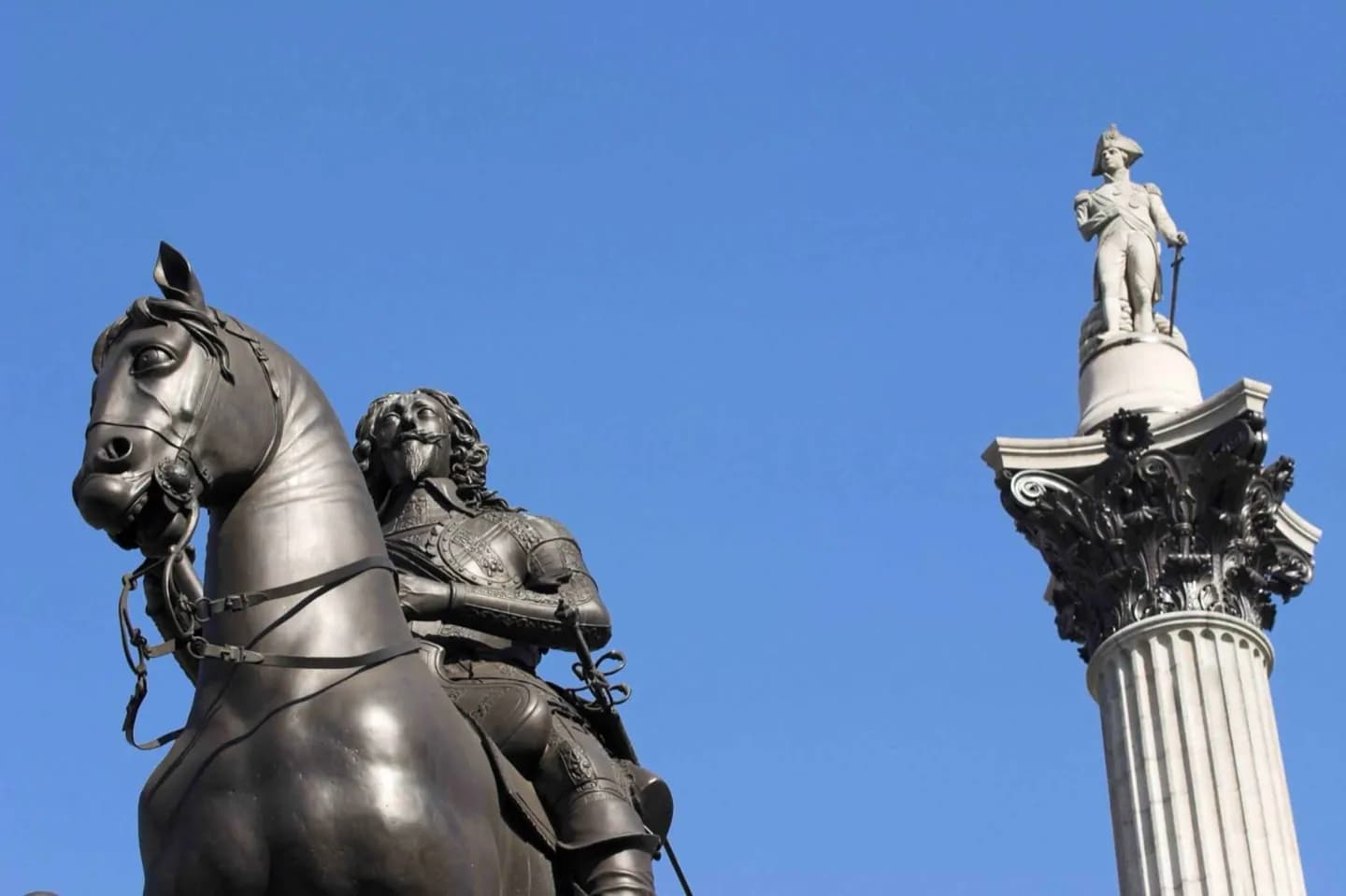
The winning entry, chosen by the sub-committee headed by the Duke of Wellington was a design by William Railton for a Corinthian column, surmounted by a statue of Nelson, and flanked by four sculpted lions. On 13 April 1995, Simon Nadin free-climbed Nelson's Column with Noel Craine, Jerry Moffat and Johnny Dawes following on top rope, and graded the climb as "E6 6b/5a".
What to look for
- The four identical bronze Barbary lions at the column's base were not added until 1867.
- Flights of steps would lead up between the lions to the pedestal of the column.
- The second prize was won by Edward Hodges Baily who suggested an obelisk surrounded by sculptures.
The full story
The monument was constructed between 1840 and 1843 to a design by William Railton at a cost of £47,000. Baily and the four bronze lions on the base, added in 1867, were designed by Sir Edwin Landseer. The pedestal is decorated with four bronze relief panels, each 18 feet square, cast from captured French guns. They depict the Battle of Cape St Vincent, the Battle of the Nile, the Battle of Copenhagen and the Death of Nelson at Trafalgar. Woodington, John Ternouth and John Edward Carew respectively. The whole monument is 169 ft 3 in (51.6 m) tall from the bottom of the pedestal to the top of Nelson's hat. Construction and history In February 1838 a group of 121 peers, MPs and other gentry formed a committee to raise a monument to Lord Nelson, funded by public subscription, and the Government agreed to provide a site in Trafalgar Square, in front of the newly completed National Gallery.
Your next visit
Estimated · Declared scenario and planning estimates; no live opening, weather, queue or booking service.
Outdoor visit · 22–45 min
World planning estimate; admission, opening, visit duration and access need checking.